
ASUS ROG Phone 6Full Specs & Is It Worth It?
- ✓Long battery life — 6,000 mAh
- ✓High-res 50 MP main camera
- ✓65W fast charging
- ✗Premium price ($999) — cheaper alternatives exist
From $999
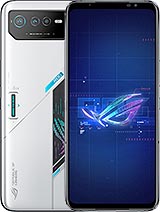
Key Specifications
Asus ROG Phone 6 Quick Answers
How much does the Asus ROG Phone 6 weigh?
The Asus ROG Phone 6 weighs 239 g and measures 173 × 77 × 10.4 mm.
What is the Asus ROG Phone 6 battery capacity?
The Asus ROG Phone 6 has a 6,000 mAh battery, with 65W wired charging.
How big is the Asus ROG Phone 6 screen?
The Asus ROG Phone 6 has a 6.78-inch display (AMOLED, 165Hz).
What processor does the Asus ROG Phone 6 use?
The Asus ROG Phone 6 runs on the Snapdragon 8+ Gen 1.
When was the Asus ROG Phone 6 released?
The Asus ROG Phone 6 was released in 2022.
ASUS ROG Phone 6 Full Specifications
| Display & Screen | |
| Display Type | AMOLED |
| Screen Size | 6.78" |
| Resolution & Density | 2448x1080 (395 ppi) |
| Refresh Rate | 165 Hz |
| Brightness | 1,200 nits peak |
| Screen Protection | Scratch-resistant glass |
| Platform & Performance | |
| Processor / Chipset | Snapdragon 8+ Gen 1 (4nm) |
| CPU | Multi-core |
| GPU | Adreno 730 |
| Operating System | Android 12 |
| Memory & Storage | |
| RAM | 16 GB LPDDR |
| Internal Storage | 256GB / 512GB |
| Storage Speed | High-speed storage |
| Cameras & Optics | |
| Main Camera | 50 MP, f/1.9, OIS, Sony IMX766 |
| Telephoto Zoom | None (Digital zoom only) |
| Ultrawide Camera | 13 MP, f/2.2 |
| LiDAR / Depth | None |
| Selfie Camera | 12 MP, f/2.45 |
| Battery & Charging | |
| Battery Capacity | 6,000 mAh |
| Wired Fast Charging | 65W |
| Wireless Charging | No |
| Body & Build | |
| Dimensions | 173 x 77 x 10.4 mm |
| Weight | 239 g |
| Build Materials | Glass front, metal frame |
| Water & Dust Resistance | IPX4 |
| Connectivity & Ports | |
| Wi-Fi | Wi-Fi 6E |
| Bluetooth | 5.3 |
| USB | USB-C 3.1 |
| NFC | Yes |
ASUS ROG Phone 6 Comparisons & Upgrade Guides
Most-searched head-to-heads and upgrade paths.
Gear for your Asus ROG Phone 6
All Amazon Finds →Similar Phones
Samsung Galaxy Tab Active5 Pro

Apple iPhone 18 Pro

Google Pixel 11 Pro 5G
OnePlus Pad 3 Pro
Xiaomi Black Shark Gaming
vivo IQOO Pad5c

Oppo Find N6 5G

Motorola Edge 60 Pro
Head-to-Head: ASUS ROG Phone 6 vs the Competition
ASUS ROG Phone 6 vs Samsung Galaxy Tab Active5 Pro
ASUS ROG Phone 6 vs Apple iPhone 18 Pro
ASUS ROG Phone 6 vs Google Pixel 11 Pro 5G
ASUS ROG Phone 6 vs OnePlus Pad 3 Pro
ASUS ROG Phone 6 vs Xiaomi Black Shark Gaming
ASUS ROG Phone 6 vs vivo IQOO Pad5c
ASUS ROG Phone 6 vs Oppo Find N6 5G
ASUS ROG Phone 6 vs Motorola Edge 60 Pro
Related Articles & Guides
All articles → Flagship Monitor Shootout
Samsung Odyssey Neo G9 57" vs. Odyssey OLED G9 49" vs. ASUS ROG Swift PG49WCD vs. LG UltraGear 45GS96QB: The Definitive Flagship Super Ultrawide & Curved Gaming Monitor Architecture, Dual 4K 7680x2160 vs. Dual QHD QD-OLED, DisplayPort 2.1 Bandwidth (UHBR 13.5/20), 240Hz Refresh Rates, 2,392 Mini-LED Local Dimming Zones vs. Infinite Contrast OLED, KVM Multitasking, and GPU Driveability Shootout (2026)
A comprehensive architectural shootout of the world's most advanced curved super ultrawide monitors. We compare Samsung's 57-inch Dual 4K Quantum Mini-LED titan against 49-inch Gen 2 QD-OLEDs and LG's 45-inch 800R curved WOLED across DisplayPort 2.1 bandwidth tunneling, 240Hz motion clarity, text rendering subpixel matrices, multi-window KVM workflows, and GPU horsepower requirements.
 Prosumer NAS Flagship Shootout
UGREEN NASync DXP4800 Plus vs. Synology DiskStation DS923+ vs. QNAP TS-464 vs. Asustor Lockerstor 4 Gen3 (AS6804T): The Definitive Flagship 4-Bay NAS Architecture, 10GbE Networking, Intel Core i5 vs. AMD Ryzen vs. Celeron Silicon, Plex 4K Hardware Transcoding, M.2 NVMe Storage Pools, and Private Cloud OS Showdown (2026)
We compared the four leading 4-bay prosumer NAS appliances across 10GbE multi-gig sequential throughput, Plex 4K HEVC/AV1 hardware transcoding, dual M.2 NVMe SSD storage pools, Docker container workloads, and OS security models. Here is the definitive data-driven benchmark breakdown.
 Flagship WiFi 7 Shootout
TP-Link Deco BE85 vs. ASUS ROG Rapture GT-BE98 Pro vs. Netgear Orbi 970 vs. Amazon eero Max 7: The Definitive Flagship WiFi 7 Mesh & Gaming Router Architecture, 320MHz Channels, 4K-QAM, Multi-Link Operation (MLO), 10Gbps Multi-Gig WAN/LAN, Broadcom vs. Qualcomm Silicon, and Real-World Latency Showdown (2026)
An exhaustive architectural and benchmark breakdown of the top 4 flagship WiFi 7 networking systems—analyzing 320MHz channel bonding, Multi-Link Operation (MLO) aggregation, Broadcom BCM4916 vs. Qualcomm Networking Pro 1220/1620 processors, 10GbE backhaul throughput, and ultra-low jitter VR/gaming performance.