Top 5 Graphics Cards
on Amazon
Our #1 pick is the Gigabyte Radeon RX 9070 XT Gaming OC. From a 16 GB Radeon for 1080p and 1440p to an RTX 5080 for 4K. We compared the 5 best graphics cards on Amazon and which resolution each one is built for.
How we picked: we shortlist by Amazon Best Seller rank and number of ratings, then compare published specs. We don't test these products hands-on.
By Jamilur Rahman, Founder & Editor · Updated October 10, 2026
- Owner reviews checked
- Features side by side
- Quick & easy compare
- Smarter purchase
The short answer
For most PC builders gaming at 1440p, the Radeon RX 9070 XT is the graphics card to buy. Independent benchmarks generally put it close to the RTX 5070 Ti in regular (non-ray-traced) games, it has a roomy 16 GB of memory, and the Gigabyte Gaming OC model costs hundreds less than the cheapest 5070 Ti here. It also handles 4K in many games with upscaling turned on.
If you want NVIDIA’s extras (stronger ray tracing, DLSS 4 with multi-frame generation, and the best support in creative apps), get the RTX 5070 Ti; the ASUS TUF version is one of the best-reviewed cards on Amazon. For high-refresh 4K, step up to the RTX 5080. Building in a small case? The ASUS Prime RTX 5070 SFF-Ready is only 2.5 slots thick. And for 1080p or entry 1440p, the RX 9060 XT 16 GB is the sensible budget pick.
A word on price: graphics cards on Amazon are selling well above their launch prices right now, so use the price bands below as a guide and compare a few brands of the same chip. Skip the 9070 XT if you play mostly ray-traced or path-traced games, or rely on NVIDIA-only tools like CUDA for video or AI work. In those cases, the RTX 5070 Ti is worth its higher price.
Compare them side by side
Everything that matters, in one table. Swipe to see all 5.
| Product | Best Overall Gigabyte Radeon RX 9070 XT Gaming OC 16 GB GDDR6 graphics card |  Best NVIDIA Card ASUS TUF Gaming RTX 5070 Ti 16 GB GDDR7 graphics card |  Best for 4K Gigabyte RTX 5080 Gaming OC 16 GB GDDR7 graphics card |  Best for Small Builds ASUS Prime RTX 5070 SFF-Ready 12 GB GDDR7 graphics card |  Best Budget XFX Swift RX 9060 XT 16 GB 16 GB GDDR6 graphics card |
|---|---|---|---|---|---|
| BeastScore | 92 / 100 | 91 / 100 | 89 / 100 | 86 / 100 | 84 / 100 |
| Best for | High-refresh 1440p gaming | 1440p and 4K with ray tracing | High-refresh 4K gaming | Small-form-factor and mid-size cases | 1080p and entry 1440p |
| Typical price (checked October 10, 2026) | $800–$850 | $1,300–$1,400 | $1,650–$1,750 | $800–$850 | $500–$550 |
| GPU | AMD Radeon RX 9070 XT | NVIDIA GeForce RTX 5070 Ti | NVIDIA GeForce RTX 5080 | NVIDIA GeForce RTX 5070 | AMD Radeon RX 9060 XT |
| Memory | 16 GB GDDR6 | 16 GB GDDR7 | 16 GB GDDR7, 256-bit | 12 GB GDDR7 | 16 GB GDDR6 |
| Size | Triple-fan (see listing) | 3.125-slot, triple fan | Triple-fan (see listing) | 2.5-slot, SFF-Ready | Dual fan |
| Power supply | See listing | 850 W with 16-pin 12V-2x6 | See listing | See listing | See listing |
| Key features |
|
|
|
|
|
BeastScore here is our overall rating out of 100, based on published specs and Amazon owner reviews. Prices change daily, so tap "View on Amazon" for today's price. We may earn a small commission, at no extra cost to you. Learn more
Why each one made the list
What each pick does best, where it falls short, and the typical Amazon price when we checked.
- 1. Best Overall
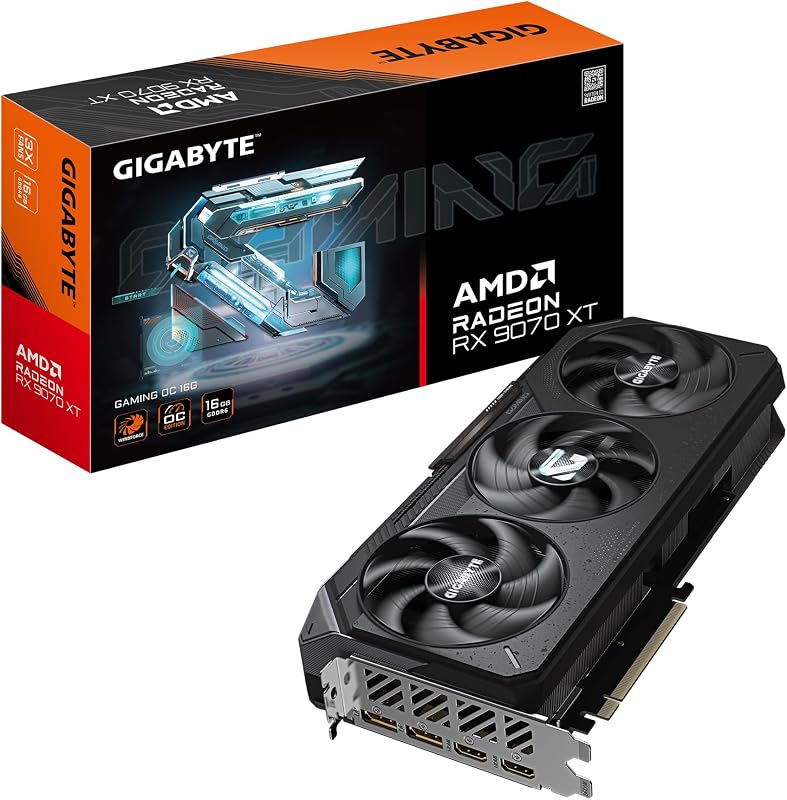
Gigabyte Radeon RX 9070 XT Gaming OC
BeastScore 92 / 100Typically $800–$850 on Amazon (checked October 10, 2026)The RX 9070 XT is AMD’s best RDNA 4 card, and it is the smartest buy for a 1440p build. In regular raster games, independent benchmarks generally put it close to the RTX 5070 Ti, yet this Gigabyte model sells for hundreds less. You get 16 GB of GDDR6, enough for high texture settings for years, and PCIe 5.0. Gigabyte’s WINDFORCE triple-fan cooler with server-grade thermal gel keeps it running cool. It is one of the best-reviewed 9070 XT cards on Amazon. The trade-offs: ray tracing is a step behind NVIDIA, and it lacks NVIDIA-only features like CUDA and DLSS multi-frame generation.
Pros- Near-5070 Ti raster speed for far less
- 16 GB of memory for future games
- Big triple-fan cooler keeps temps in check
Cons- Ray tracing trails NVIDIA’s cards
- No CUDA for creative and AI apps
- Large card: check your case length
- 2. Best NVIDIA Card
ASUS TUF Gaming RTX 5070 Ti
BeastScore 91 / 100Typically $1,300–$1,400 on Amazon (checked October 10, 2026)If you want NVIDIA, the RTX 5070 Ti is the sweet spot, and the ASUS TUF is one of the best-reviewed versions on Amazon. It uses the Blackwell chip with DLSS 4, so supported games can multiply frame rates with AI frame generation, and its ray tracing is clearly ahead of AMD’s. 16 GB of GDDR7 gives it room for 4K textures. ASUS adds a phase-change thermal pad, a protective PCB coating and military-grade parts for a long life. The cons are size and cost: the listing says it is 3.125 slots thick and needs an 850 W power supply with a 16-pin 12V-2x6 cable.
Pros- Strong ray tracing and DLSS 4 frame generation
- 16 GB GDDR7 for 1440p and 4K
- Premium TUF build with phase-change thermal pad
Cons- Costs far more than the RX 9070 XT
- Thick 3.125-slot card needs a roomy case
- Needs an 850 W PSU with a 16-pin cable
- 3. Best for 4K
Gigabyte RTX 5080 Gaming OC
BeastScore 89 / 100Typically $1,650–$1,750 on Amazon (checked October 10, 2026)The RTX 5080 is the card for 4K screens and high-refresh 1440p monitors. It is NVIDIA’s second-fastest gaming GPU, with 16 GB of GDDR7 on a 256-bit bus and DLSS 4, so heavy ray-traced games stay smooth at 4K with upscaling and frame generation on. Gigabyte’s Gaming OC uses the WINDFORCE triple-fan cooler and is one of the better-priced 5080s on Amazon. The downsides are clear: it costs about twice as much as the RX 9070 XT, it is a big card that needs real airflow, and 16 GB is the same as the cheaper cards here, so it won’t last longer on memory alone.
Pros- Fastest card here for 4K and ray tracing
- DLSS 4 multi-frame generation
- Fast GDDR7 on a 256-bit bus
Cons- About twice the price of the RX 9070 XT
- Same 16 GB as cheaper cards
- Large card, needs good case airflow
- 4. Best for Small Builds
ASUS Prime RTX 5070 SFF-Ready
BeastScore 86 / 100Typically $800–$850 on Amazon (checked October 10, 2026)Not every PC has room for a three-slot monster. The ASUS Prime RTX 5070 is SFF-Ready, meaning it fits small-form-factor cases, and the listing says it is just 2.5 slots thick. You still get DLSS 4, NVIDIA’s ray tracing and HDMI and DisplayPort 2.1, plus a dual BIOS switch and a 3-year warranty. It is a strong 1440p card, and it is one of the most-reviewed RTX 5070s on Amazon. The catch is memory: 12 GB is less than every other card here, which can limit texture settings in the newest games, and it costs about the same as the faster RX 9070 XT.
Pros- Slim 2.5-slot design fits small cases
- DLSS 4 and good ray tracing for 1440p
- Dual BIOS and a 3-year warranty
Cons- Only 12 GB of memory
- Costs about the same as the faster RX 9070 XT
- Not a 4K card in heavy games
- 5. Best Budget
XFX Swift RX 9060 XT 16 GB
BeastScore 84 / 100Typically $500–$550 on Amazon (checked October 10, 2026)The RX 9060 XT is the budget card that doesn’t skimp on memory. This XFX Swift model has 16 GB of GDDR6, more than many pricier cards, so it handles high textures at 1080p and lighter 1440p games without stutter. The listing says it boosts up to 3320 MHz and uses XFX’s compact dual-fan SWFT cooler, which fits most mid-size cases. Make sure you get the 16 GB version, not the cheaper 8 GB one. The trade-offs: it is clearly slower than the 9070 XT, ray tracing is weak, and it isn’t a 4K card. It also isn’t cheap by old standards, because GPU prices are high right now.
Pros- 16 GB of memory at the lowest price here
- Compact dual-fan card fits most cases
- Strong 1080p and solid 1440p performance
Cons- Not built for 4K
- Weak ray tracing
- Priced above its launch price right now
All 5 compared, in one look
See every pick on one chart, or tap one to put it head to head with Gigabyte Radeon RX 9070 XT Gaming OC. Ratings out of 10 are our estimates from published specs and Amazon owner reviews, not hands-on tests. Bigger shape = better.
- 1440pGigabyte RTX 5080 Gaming OC · 9.8/10
- 4KGigabyte RTX 5080 Gaming OC · 9.6/10
- Ray tracingGigabyte RTX 5080 Gaming OC · 9.6/10
- MemoryTie
- Size & powerASUS Prime RTX 5070 SFF-Ready · 9.4/10
- ValueXFX Swift RX 9060 XT 16 GB · 9.4/10
Gigabyte Radeon RX 9070 XT Gaming OC
Near-RTX 5070 Ti speed at 1440p and 16 GB of memory, for hundreds less.
- 16 GB GDDR6
- Great 1440p value
- Triple-fan cooling
Quick tips before you buy
Check card length and slot thickness against your case before you buy, especially for 3-slot cards.
Match the listing’s PSU wattage and connectors. Many RTX 50 cards need a 16-pin 12V-2x6 cable.
RX 9060 XT for 1080p, RX 9070 XT or RTX 5070 Ti for 1440p, RTX 5080 for 4K.
Big GPUs dump a lot of heat. Add intake and exhaust fans so the card doesn’t throttle.
Quick answers
What is the best graphics card right now?+
For most 1440p gamers, the Radeon RX 9070 XT is the best value. If you want NVIDIA’s ray tracing and DLSS 4, get the RTX 5070 Ti. For 4K, the RTX 5080.
RTX 5070 Ti vs RX 9070 XT: which should I buy?+
In regular games they are close, and the 9070 XT costs much less. The 5070 Ti wins in ray tracing, DLSS 4 frame generation and creative apps that use CUDA. Pick AMD for value, NVIDIA for ray tracing and features.
How much VRAM do I need in 2026?+
12 GB is the minimum for 1440p, and 16 GB is the safer choice for high textures and 4K. That’s why the 16 GB RX 9060 XT is a better budget buy than 8 GB cards.
Why are graphics cards so expensive right now?+
Amazon prices for most RTX 50 and RX 9000 cards are well above their launch prices. Compare a few brands of the same chip, since prices for the same GPU can differ by $100 or more.
What power supply do I need for an RTX 5070 Ti?+
The ASUS TUF listing asks for at least an 850 W power supply with a 16-pin 12V-2x6 connector. Always follow the requirement on the exact card you buy.
Is the RTX 5080 worth it over the 5070 Ti?+
Only for 4K or very high refresh rates. It is faster, but both have 16 GB of memory, and the 5080 costs several hundred dollars more.