
Top 5 STEM Toys
on Amazon
Our #1 pick is the Snap Circuits Classic SC-300. Circuits, chemistry, coding and engineering. We compared the 5 best STEM toys on Amazon for kids from 5 to 12, from a budget hydraulic hand to a coding robot set.
How we picked: we shortlist by Amazon Best Seller rank and number of ratings, then compare published specs. We don't test these products hands-on.
By Jamilur Rahman, Founder & Editor · Updated October 9, 2026
- Owner reviews checked
- Features side by side
- Quick & easy compare
- Smarter purchase
The short answer
For most kids aged 8 and up, Snap Circuits Classic SC-300 is the STEM toy to buy. It turns electronics into a snap-together puzzle: kids follow the color-coded manual to build more than 300 projects, from a doorbell to an AM radio, with no soldering or tools. It has been a classroom and holiday favorite for years, it grows with the child, and it often costs less than a new video game.
For younger kids (5 and up), the Botley 2.0 Coding Robot Activity Set teaches the logic of coding with no screen at all. Kids who love messy experiments will get more from the National Geographic Mega Science Lab, with 45 chemistry, earth science and science-magic experiments in one box. For a lower budget, ThinkFun Gravity Maze is a marble logic game that adults enjoy too, and the Thames & Kosmos Mega Cyborg Hand is a build-it-yourself hydraulic hand for under $30.
Skip Snap Circuits for kids under 8 or for kids who don’t like following instructions: much of the fun is in building from the manual, step by step. It also needs AA batteries, which are not in the box. If your child mostly wants to play with something right away, Botley or Gravity Maze is the better gift. And for teens already into code, look at programmable boards or app-based robots instead of anything on this list.
Compare them side by side
Everything that matters, in one table. Swipe to see all 5.
| Product | Best Overall Snap Circuits Classic SC-300 Electronics kit |  Best for Young Kids Botley 2.0 Coding Robot Activity Set Screen-free coding robot |  Best Science Kit National Geographic Mega Science Lab Science experiment kit |  Best Logic Game ThinkFun Gravity Maze Logic game |  Best Under $30 Thames & Kosmos Mega Cyborg Hand Hydraulic engineering kit |
|---|---|---|---|---|---|
| BeastScore | 93 / 100 | 90 / 100 | 88 / 100 | 89 / 100 | 85 / 100 |
| Best for | Kids 8+ who like building | Ages 5 to 8, first steps in coding | Hands-on chemistry and earth science | Problem solvers, solo or with family | Budget gift for young engineers |
| Typical price (checked October 9, 2026) | $35–$60 | $80–$110 | $50–$70 | $30–$40 | $20–$30 |
| Ages | 8+ | 5+ | 8–12 | 8+ | See listing |
| Main skill | Electronics and circuits | Coding logic and sequencing | Chemistry and earth science | Spatial reasoning and planning | Hydraulics and mechanics |
| Projects / challenges | 300+ projects | 40 coding cards, 6 boards | 45 experiments + 30 bonus | Challenge cards, see listing | One build, 3 configurations |
| Batteries | Required, see listing | See listing | None | None | None |
| Key features |
|
|
|
|
|
BeastScore here is our overall rating out of 100, based on published specs and Amazon owner reviews. Prices change daily, so tap "View on Amazon" for today's price. We may earn a small commission, at no extra cost to you. Learn more
Why each one made the list
What each pick does best, where it falls short, and the typical Amazon price when we checked.
- 1. Best Overall
Snap Circuits Classic SC-300
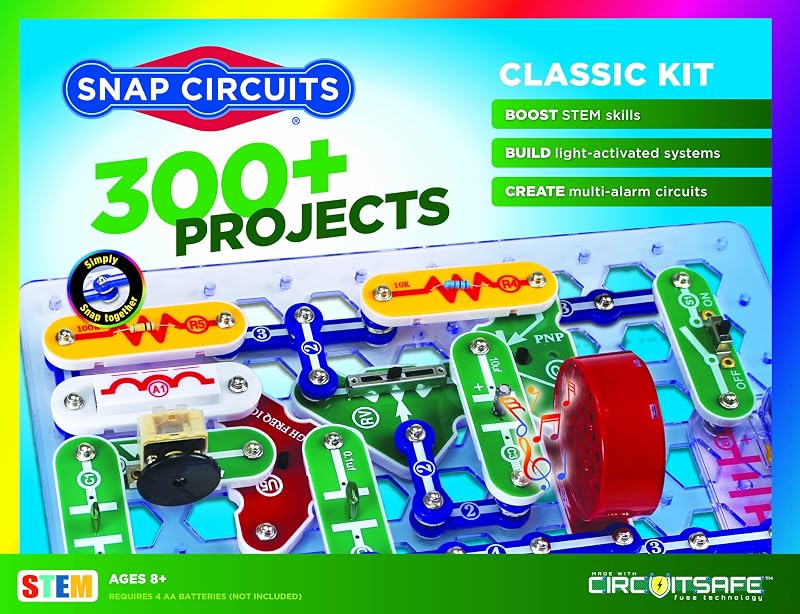
BeastScore 93 / 100Typically $35–$60 on Amazon (checked October 9, 2026)Snap Circuits is the rare educational toy kids actually keep using. The listing says the box has 60+ color-coded parts that snap onto a plastic grid to build more than 300 projects: AM radios, burglar alarms, doorbells and simple games. There is no soldering and no tools, so an 8-year-old can work alone while learning how switches, resistors and circuits really work. It has won several toy awards, and owners report kids going back to it for years. The downsides: it needs batteries, the small parts get lost, and kids who dislike manuals may lose interest.
Pros- 300+ projects give months of building
- Teaches real electronics with no tools or soldering
- Expandable with other Snap Circuits sets
Cons- Batteries are not included
- Small parts are easy to lose without a tray
- Manual-driven play won’t suit every child
- 2. Best for Young Kids
Botley 2.0 Coding Robot Activity Set
BeastScore 90 / 100Typically $80–$110 on Amazon (checked October 9, 2026)Botley teaches coding without a tablet. Kids lay out a path, then press arrow buttons on the remote programmer to give the robot a sequence of steps and watch whether it gets there. The listing says the 78-piece set includes the robot, 40 coding cards, six double-sided boards and stackable obstacles to build mazes. As kids improve, Botley 2.0 adds 45° turns, multi-step paths, object sensing and 16 secret codes. Owners say it holds attention well past the first week. It costs more than the other picks, needs batteries and is best below age 9.
Pros- Teaches real coding logic with no screen
- Big set with cards, boards and obstacles
- Grows with kids: turns, longer paths and sensing
Cons- Most expensive pick here
- Older kids outgrow it quickly
- Batteries needed (see listing)
- 3. Best Science Kit
National Geographic Mega Science Lab
BeastScore 88 / 100Typically $50–$70 on Amazon (checked October 9, 2026)This is three kits in one. The listing says it includes 45 experiments across earth science, chemistry and science magic, plus a bonus guide with 30 more experiments using things you already have at home. Kids build and erupt a volcano, grow a glow-in-the-dark crystal, make water tornadoes, dig out a real fossil and launch a gas-powered rocket. It also comes with real rock and mineral specimens to keep. Parents like the wow factor. The trade-off is that most experiments are one-time uses, so it has less replay value than Snap Circuits, and some need adult help.
Pros- 45 experiments plus 30 bonus ones
- Real rocks, minerals and a fossil to keep
- Big wow factor for kids who love mess
Cons- Many supplies are single-use
- Some experiments need an adult nearby
- Less replay value than a building kit
- 4. Best Logic Game
ThinkFun Gravity Maze
BeastScore 89 / 100Typically $30–$40 on Amazon (checked October 9, 2026)Gravity Maze is a marble run with a puzzle on top. Each challenge card shows some tower pieces already on the grid; the player must add the rest so a marble dropped at the top reaches the target. The listing says the box has 9 towers, 3 marbles, a game grid and a target piece. Cards ramp from beginner to expert, so an 8-year-old and a parent can both be stumped. It has one of the largest owner bases of any STEM toy on Amazon, and it is a common teacher pick. The limits: once all cards are solved, free building is the main play.
Pros- Builds planning and spatial skills
- No batteries, setup or screens
- Fun for adults too, so it works for family play
Cons- Fixed set of challenges
- Small pieces can go missing
- Less hands-on science than the kits here
- 5. Best Under $30
Thames & Kosmos Mega Cyborg Hand
BeastScore 85 / 100Typically $20–$30 on Amazon (checked October 9, 2026)This kit builds a big, wearable mechanical hand that you work with your own fingers. The listing says there are no motors or batteries: hydraulic pistons filled with water move the fingers open and closed with enough force to grip and lift objects. It builds as a right hand, left hand or claw, and each finger joint adjusts. It won the Toy Association’s STEAM Toy of the Year in 2021. Kids learn how hydraulics power real industrial robots. Owners say the build takes patience and adult help for younger kids, and once it is built, the play is mostly with the finished hand.
Pros- Big wearable result kids love showing off
- Teaches hydraulics with no batteries
- Award-winning kit at a low price
Cons- Fiddly build that may need an adult
- One main project, less replay value
- Uses water in the pistons, so the build gets a bit messy
All 5 compared, in one look
See every pick on one chart, or tap one to put it head to head with Snap Circuits Classic SC-300. Ratings out of 10 are our estimates from published specs and Amazon owner reviews, not hands-on tests. Bigger shape = better.
- Learning valueSnap Circuits Classic SC-300 · 9.6/10
- Fun factorTie
- Replay valueSnap Circuits Classic SC-300 · 9.4/10
- Easy setupThinkFun Gravity Maze · 9.4/10
- DurabilitySnap Circuits Classic SC-300 · 9.2/10
- ValueTie
Snap Circuits Classic SC-300
Over 300 real electronics projects with no tools, and it lasts for years.
- 300+ projects
- No soldering
- Ages 8+
Quick tips before you buy
A kit that is too hard gets abandoned. Check the age on the box and pick slightly below if your child is new to STEM.
Snap Circuits and Botley need batteries that are not in the box. Buy them with the gift.
Building kits and logic games keep getting used. Experiment kits are great but run out of supplies.
Most STEM toys have small pieces. Keep them away from toddlers and give older kids a tray or box.
Quick answers
What is the best STEM toy for an 8-year-old?+
Snap Circuits Classic SC-300. It is made for ages 8 and up, needs no tools, and has more than 300 projects, so it lasts well beyond the first week.
What is a good STEM toy for a 5-year-old?+
A screen-free coding robot like Botley 2.0. Kids program it with arrow buttons, which teaches sequencing and logic before they can read code.
Are STEM toys actually educational?+
The good ones are. The best STEM toys let kids test an idea, see it fail and fix it, which is how real science and engineering work. Toys that only follow one set of steps teach less than open-ended kits like Snap Circuits.
Snap Circuits SC-300 vs SC-100: which should I buy?+
The SC-100 (Jr.) has about 100 projects and fewer parts, so it is cheaper and a gentler start. The SC-300 has 300+ projects and keeps kids busy much longer. For most kids 8 and up, the SC-300 is the better value.
Do coding robots need a tablet or phone?+
Not all of them. Botley 2.0 is fully screen-free and uses a remote programmer. Many robots for older kids use an app, which gives more power but more screen time.
Are science kits safe for kids?+
Kits like the National Geographic Mega Science Lab are made for ages 8 to 12, but some experiments use powders, vinegar or small parts. An adult should be nearby, and kids should follow the guide and wash hands after.


