Closest to your 20,000 mAh
Best 20,000 mAh
Samsung Power Bank 20,000 mAh 45W
Best for trips, camping and charging a laptop
- 20,000 mAh · 74 Wh
- 2.9 charges of an iPhone 17 Pro
- OK in carry-on
- 45 W max output
Usually $40–$50Checked Oct 29, 2026

Pick your power bank’s size and your phone, tablet or laptop. It turns mAh into watt-hours, shows in 3D how many devices it fully charges, checks the airline limit for carry-on bags, and lists power banks that fit.
20,000 mAh power bank · iPhone 17 Pro · cable
About 2.9 full charges of an iPhone 17 Pro
A 20,000 mAh power bank holds about 74 Wh. Over a cable, about 65% of that (48.1 Wh) gets into the battery, and the iPhone 17 Pro battery takes 16.4 Wh for a full charge. Topping up from 20% to 100% instead, you get 3.7 charges.
20,000 mAh (74 Wh): OK in carry-on
At 74 Wh it is under the 100 Wh limit, so it can go in your carry-on bag with no approval.
These are the FAA rules for US flights. Other countries are similar but not identical, and some airlines now restrict using a power bank during the flight, so check your airline. The Wh printed on the bank is the number that counts.
Common sizes
Battery: 4,252 mAh (16.4 Wh). Source: BeastCompare phone database.
How you charge
We assume about 65% of the bank’s energy reaches the phone over a cable and 50% over wireless, because of voltage conversion and heat.
Energy figures use 3.7 V for the power bank and 3.85 V for phone batteries. The 65% is a typical figure, not a lab result: a cheap cable, a thick case or using the phone while it charges lowers it.
Closest in size to your 20,000 mAh, with the charges for an iPhone 17 Pro worked out for each.
Best 20,000 mAh
Best for trips, camping and charging a laptop
Also worth a look

Best Overall
Anker Nano 45W (10,000 mAh)
Best for fast charging for phones and small laptops
Best Price Per Unit
Anker Nano 30W (10,000 mAh), Pack of 2
Best for two people, or a bag plus a desk

Best Budget
Charmast 10,000 mAh with 4 Built-in Cables
Best for families with mixed phones and cables

Best Magnetic
Anker 621 MagGo (5,000 mAh), Pack of 2
Best for iPhone users who want a cable-free top-up
As an Amazon Associate, BeastCompare earns from qualifying purchases, at no extra cost to you. Prices change often, so tap through for today’s price. How we make money
Full charges from 0 to 100% over a cable, counting about 65% of the bank’s energy reaching the phone. Over magnetic wireless charging, expect about 77% of these numbers. Use the calculator above for your own phone, tablet or laptop.
| Power bank | Energy | iPhone 17 | iPhone 17 Pro Max | Galaxy S26 Ultra | Pixel 10 | On a plane? |
|---|---|---|---|---|---|---|
| 5,000 mAh | 18.5 Wh | 0.8 | 0.6 | 0.6 | 0.6 | Yes, in carry-on |
| 10,000 mAh | 37 Wh | 1.7 | 1.2 | 1.2 | 1.3 | Yes, in carry-on |
| 20,000 mAh | 74 Wh | 3.4 | 2.5 | 2.5 | 2.5 | Yes, in carry-on |
| 25,000 mAh | 92.5 Wh | 4.2 | 3.1 | 3.1 | 3.1 | Yes, in carry-on |
| 27,000 mAh | 99.9 Wh | 4.6 | 3.3 | 3.4 | 3.4 | Yes, in carry-on |
| 30,000 mAh | 111 Wh | 5.1 | 3.7 | 3.7 | 3.8 | Needs airline approval |
| 40,000 mAh | 148 Wh | 6.8 | 4.9 | 5 | 5 | Needs airline approval |
mAh is not energy, so we convert to watt-hours. A power bank’s mAh is counted at its battery cells’ voltage, about 3.7 V, and a phone battery’s mAh at about 3.85 V, so the two can’t be compared directly. We turn both into watt-hours (Wh = mAh × volts ÷ 1,000). A 20,000 mAh bank holds 20,000 × 3.7 ÷ 1,000 = 74 Wh. An iPhone 17 Pro battery of 4,252 mAh holds 4,252 × 3.85 ÷ 1,000 = 16.4 Wh. Tablets and laptops are listed in Wh by their makers, so we use that figure as it is.
Not all of that energy reaches your phone. Charging loses some to voltage conversion and heat. We assume 65% gets in over a cable and 50% over magnetic wireless charging. These are assumptions, not lab results: expect about 60 to 70% over a cable and roughly half over magnetic wireless, and a bit less with a cheap cable, a thick case or a phone you use while it charges. Charges = the bank’s Wh × that share ÷ the device’s Wh.
Two ways to count a charge. The main number is a full charge from 0 to 100%, which is how most people ask the question. We also show top-ups from 20% to 100%, which is how phones are really used and gives about a quarter more. A bank that gives 0.8 of a full charge or more can take a phone from 20% back to full.
Where the battery sizes come from. Phone batteries are the published capacities in BeastCompare’s phone database, each linked to its phone page. The Nintendo Switch 2 battery comes from Nintendo, and the iPad Air and MacBook Air energy from Apple’s tech specs. Pick “Custom” to type your own device’s mAh. Laptops also need real USB-C power output: about 30 W or more from the power bank to charge while you use them. That is a rule of thumb: with less, a laptop may charge very slowly, or not at all, while you work. Only phones charge wirelessly, so for tablets, laptops and consoles we use the cable figure.
The plane rule (FAA, for US flights). Spare lithium batteries, which includes power banks, must go in your carry-on bag, never in checked luggage. Up to 100 Wh (about 27,000 mAh) is allowed with no approval. From 100 to 160 Wh (about 27,000 to 43,000 mAh) you need the airline’s approval and can carry two at most. Over 160 Wh is not allowed on passenger planes. Other countries are similar but not identical, and some airlines now limit using a power bank during the flight, so check your airline before you fly. The Wh printed on the bank is the number that counts.
By Jamilur Rahman. Prices on this page are from our guides and change on Amazon; we earn from qualifying purchases.
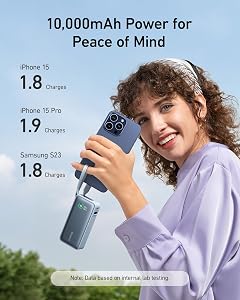
About 1.5 full charges of an iPhone 17 Pro or a Galaxy S26, 1.7 of an iPhone 17 and 1.2 of an iPhone 17 Pro Max or a Galaxy S26 Ultra, over a cable. The bank holds 37 Wh and about 65% of that reaches your phone. That is well short of the 2.4 you get by dividing 10,000 by an iPhone 17 Pro’s 4,252 mAh, because of the voltage difference and what is lost in charging.
About 2.9 full charges of an iPhone 17 Pro, 3.4 of an iPhone 17 and 2.5 of an iPhone 17 Pro Max or a Galaxy S26 Ultra, over a cable. It holds 74 Wh, and 48.1 Wh of that gets into your phone. If you top up from 20% instead of 0%, an iPhone 17 Pro gets about 3.7 charges.
Less than one full charge: about 0.7 of an iPhone 17 Pro, 0.8 of an iPhone 17 and 0.6 of a Galaxy S26 Ultra over a cable. It is a top-up bank: from 20% it takes an iPhone 17 to full about 1.1 times. Over magnetic wireless charging it gives about 0.7 of an iPhone 17.
About 1.7 times for an iPhone 17 and 1.5 times for an iPhone 17 Pro, over a cable, from empty to 100%. From 20%, that is 2.1 and 1.8 top-ups. Over magnetic wireless charging it drops to about 1.3 and 1.1 full charges, because wireless wastes more energy as heat.
Yes: about 2.5 full charges over a cable. The bank holds 74 Wh and 48.1 Wh of it reaches the phone, and a 5,000 mAh phone battery holds 19.3 Wh. From 20% to 100% that is 3.1 top-ups.
Yes, in your carry-on bag. 20,000 mAh at 3.7 V is 74 Wh, under the FAA’s 100 Wh limit, so you need no approval. Never pack it in checked luggage. Some airlines now limit using a power bank during the flight, so check yours.
Yes, in your carry-on bag. 10,000 mAh is 37 Wh, well under the 100 Wh limit. Power banks are never allowed in checked bags, and some airlines restrict using one in the air, so check your airline.
Up to 100 Wh, about 27,000 mAh (a 27,000 mAh bank is 99.9 Wh), in carry-on with no approval. From 100 to 160 Wh (about 27,000 to 43,000 mAh) you need the airline’s OK and can bring two at most. Over 160 Wh is not allowed. Trust the Wh printed on the bank: some brands rate mAh at a different voltage.
The iPhone 17 Pro Max battery is 5,088 mAh (19.6 Wh). To charge it fully once over a cable you need about 8,100 mAh in the power bank, because of what is lost on the way. As a rule of thumb, a bank needs about 1.6 times the phone’s mAh. A 10,000 mAh bank gives it 1.2 charges and a 20,000 mAh bank 2.5.