
Huawei nova 12 Pro vs Xiaomi Redmi Note 15 Special Edition 5G: Which One Should You Buy?
Xiaomi Redmi Note 15 Special Edition 5G edges ahead with a BeastScore of 88.5/100 — but the right choice depends on what matters to you.
Huawei nova 12 Pro

Xiaomi Redmi Note 15 Special Edition 5G

Xiaomi Redmi Note 15 Special Edition 5G wins 3 of 5 categories
Here's exactly where each phone is stronger.
Bigger shape = better phone.
Scores out of 100. How we score
- SpeedXiaomi Redmi Note 15 Special Edition 5G9095
- CameraHuawei nova 12 Pro9180
- VideoNot enough data
- SelfieNot enough data
- BatteryXiaomi Redmi Note 15 Special Edition 5G8291
- DisplayHuawei nova 12 Pro9089
- ConnectivityNot enough data
- SecurityNot enough data
- ValueXiaomi Redmi Note 15 Special Edition 5G8085
- Xiaomi Redmi Note 15 Special Edition 5G has the bigger battery5,800 mAh vs 4,600 mAh
- Xiaomi Redmi Note 15 Special Edition 5G has the bigger screen6.77" vs 6.76"
- Huawei nova 12 Pro has more RAM12 GB vs 8 GB
- Huawei nova 12 Pro has the faster chipHiSilicon Kirin 9010 vs Snapdragon 6 Gen 3
Why buy each phone
Swipe ⇄Xiaomi Redmi Note 15 Special Edition 5G wins — BeastScore 88.5/100
The Xiaomi Redmi Note 15 Special Edition 5G is the better pick for most people thanks to its bigger battery (5,800 mAh vs 4,600 mAh) and bigger screen (6.77" vs 6.76"). The Huawei nova 12 Pro is worth a look if you prefer its more RAM (12 GB vs 8 GB).
Optical telephoto zoom (1 telephoto lens) · More RAM: 12 GB vs 8 GB
Larger battery: 5,800 mAh vs 4,600 mAh
Common questions
Which is better: Huawei nova 12 Pro or Xiaomi Redmi Note 15 Special Edition 5G?
The Xiaomi Redmi Note 15 Special Edition 5G is the better pick for most people thanks to its bigger battery (5,800 mAh vs 4,600 mAh) and bigger screen (6.77" vs 6.76"). The Huawei nova 12 Pro is worth a look if you prefer its more RAM (12 GB vs 8 GB). BeastScore: Huawei nova 12 Pro 87.7/100, Xiaomi Redmi Note 15 Special Edition 5G 88.5/100.
What are the main battery and display differences between Huawei nova 12 Pro and Xiaomi Redmi Note 15 Special Edition 5G?
Huawei nova 12 Pro has a 6.76-inch display and 4600 mAh battery. Xiaomi Redmi Note 15 Special Edition 5G has a 6.77-inch display and 5800 mAh battery.
How do Huawei nova 12 Pro and Xiaomi Redmi Note 15 Special Edition 5G compare for speed?
Huawei nova 12 Pro scores 90/100 for performance; Xiaomi Redmi Note 15 Special Edition 5G scores 95/100.
Similar Smartphones








More Smartphones comparisons
Huawei nova 12 Pro vs Huawei nova 16 Pro 5G
Huawei nova 12 Pro vs Huawei nova 15 Pro 5G
Xiaomi Redmi Note 15 Special Edition 5G vs Xiaomi Redmi Note 15 Pro (Global)
Xiaomi Redmi Note 15 Special Edition 5G vs Xiaomi Redmi Note 15 5G (China)
Xiaomi Redmi Note 15 Special Edition 5G vs Xiaomi Redmi Note 15 Pro+ 5G (China)
Xiaomi Redmi Note 15 Special Edition 5G vs Xiaomi Redmi Note 15 Pro 5G (China)
Huawei nova 12 Pro vs Galaxy S26 Ultra
Xiaomi Redmi Note 15 Special Edition 5G vs Samsung Galaxy F70 Pro 5G
Gear for the Xiaomi Redmi Note 15 Special Edition 5G
All Amazon Finds →Related articles
All articles →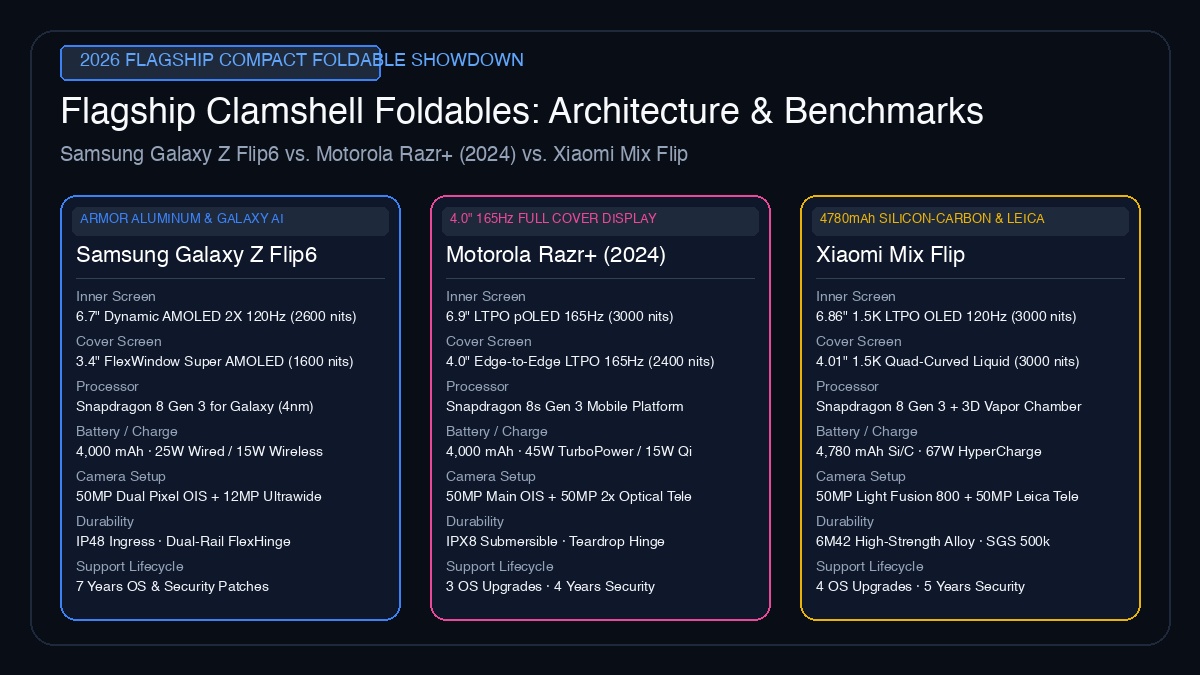 Definitive Foldable Guide 2026
Samsung Galaxy Z Flip6 vs. Motorola Razr+ (2024) vs. Xiaomi Mix Flip: The Definitive Flagship Clamshell Foldable Architecture, Outer Screen Workflows, Armor Aluminum & Titanium Hinges, Silicon-Carbon Batteries, and Dual 50MP Camera Showdown (2026)
A rigorous 2026 engineering and benchmark comparison of the top three clamshell foldables: evaluating Qualcomm Snapdragon 8 Gen 3 for Galaxy vs. 8s Gen 3, teardrop dual-rail hinge mechanics, 1.5K quad-curved vs. 165Hz cover displays, 4,780mAh silicon-carbon battery chemistry, and Leica vs. ProVisual computational photography.
Read → Update
Xiaomi starts beta test recruitment for HyperOS 4
Xiaomi has started recruiting beta testers for HyperOS 4 across eligible flagship devices, focusing on smoother animations, lower background RAM usage, and improved AI features.
Read → Acoustic Showdown
Audeze Maxwell vs. SteelSeries Arctis Nova Pro Wireless vs. Logitech G PRO X 2 LIGHTSPEED vs. Razer BlackShark V2 Pro: The Definitive Flagship Wireless Gaming & Audiophile Headset Architecture, 90mm Planar Magnetic vs. 50mm Graphene Drivers, Multi-System DAC Hubs, Hot-Swap Batteries, 2.4GHz Ultra-Low Latency, Broadcast Microphones, and Spatial Audio Imaging Showdown (2026)
An exhaustive architectural and acoustic analysis comparing planar magnetic, graphene, high-res neodymium, and titanium-coated dynamic drivers across frequency response linearity, spatial pinna cues, wireless transmission protocols, microphone intelligibility, and battery longevity.
Read →