1. Executive Summary & The Desktop Silicon Paradigm Shift
The high-performance desktop processor landscape has reached a decisive inflection point. In this generation, AMD and Intel have taken radically divergent architectural paths to solve the physical limits of semiconductor scaling, thermal density, and memory latency.
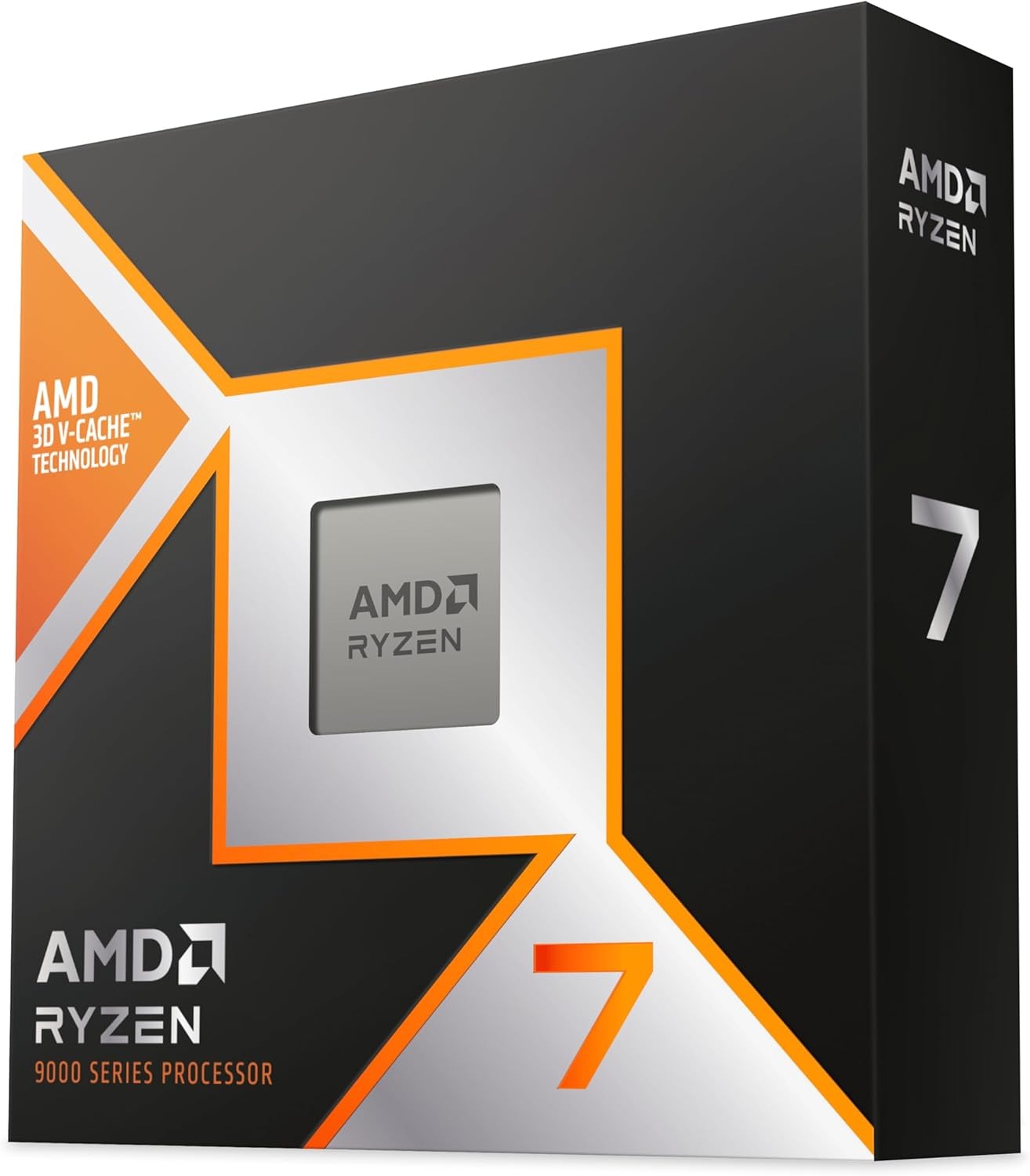
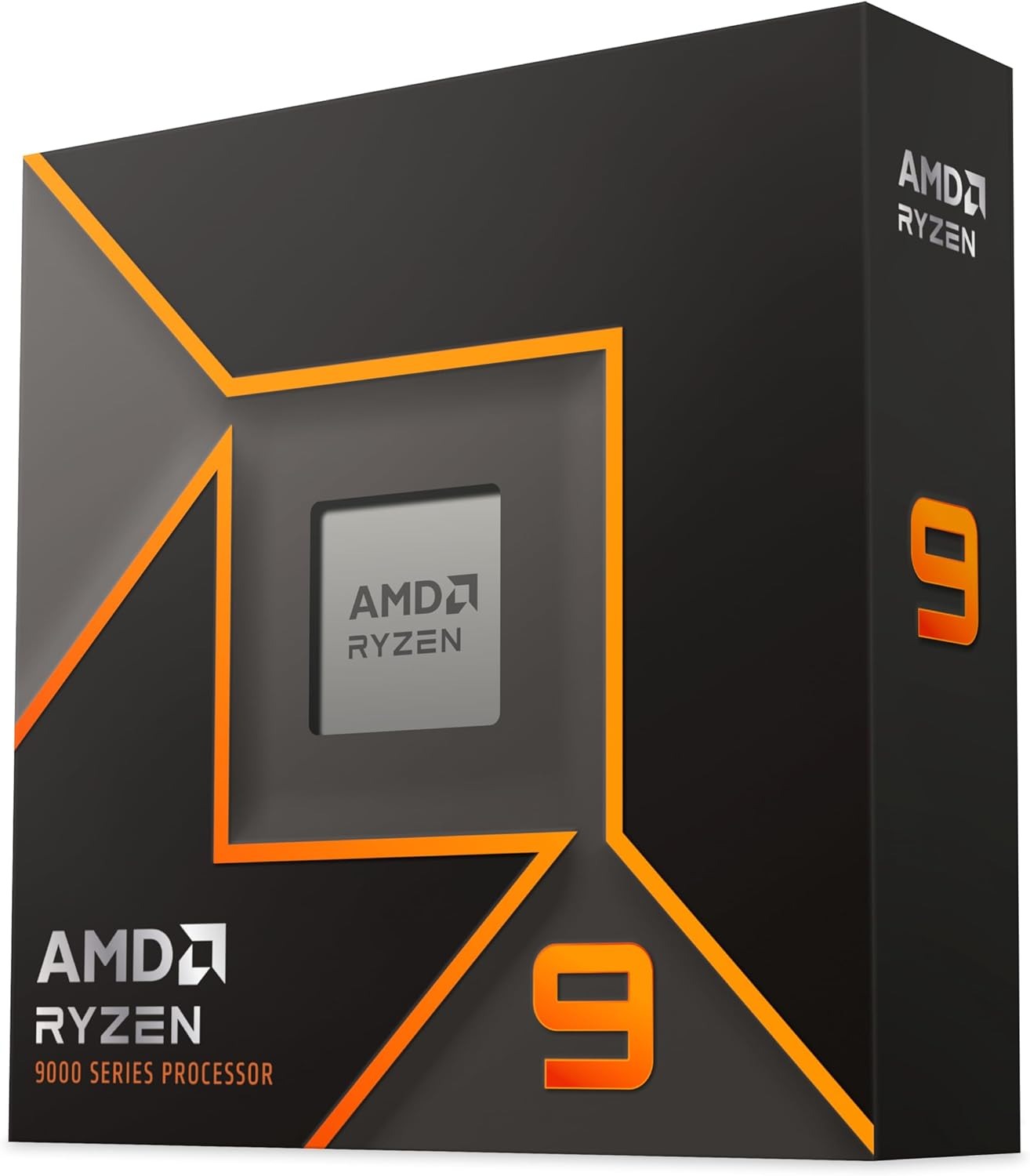
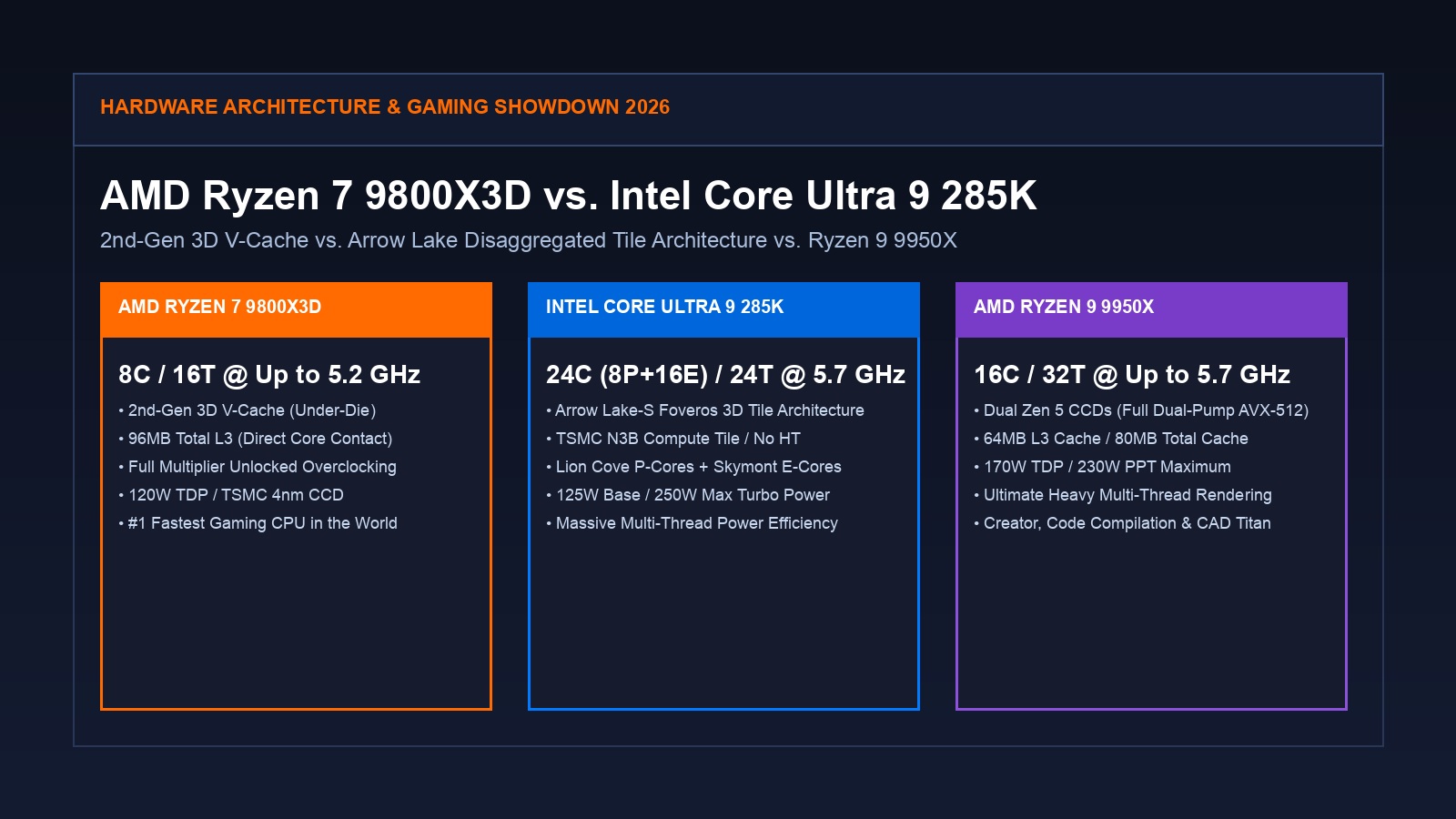
AMD's Ryzen 7 9800X3D introduces 2nd-Generation 3D V-Cache technology, completely inverting the physical silicon stacking order to place the 64MB SRAM cache tile directly underneath the compute complex. This breakthrough eliminates the thermal penalty that plagued prior X3D processors, enabling unprecedented boost clock frequencies of 5.2 GHz, full multiplier overclocking, and devastating gaming frame rates. Alongside it, the 16-core Ryzen 9 9950X harnesses dual Zen 5 Core Complex Dies (CCDs) built on TSMC's 4nm node to dominate multi-threaded rendering and mathematical computing with full dual-pumped AVX-512 pipelines.
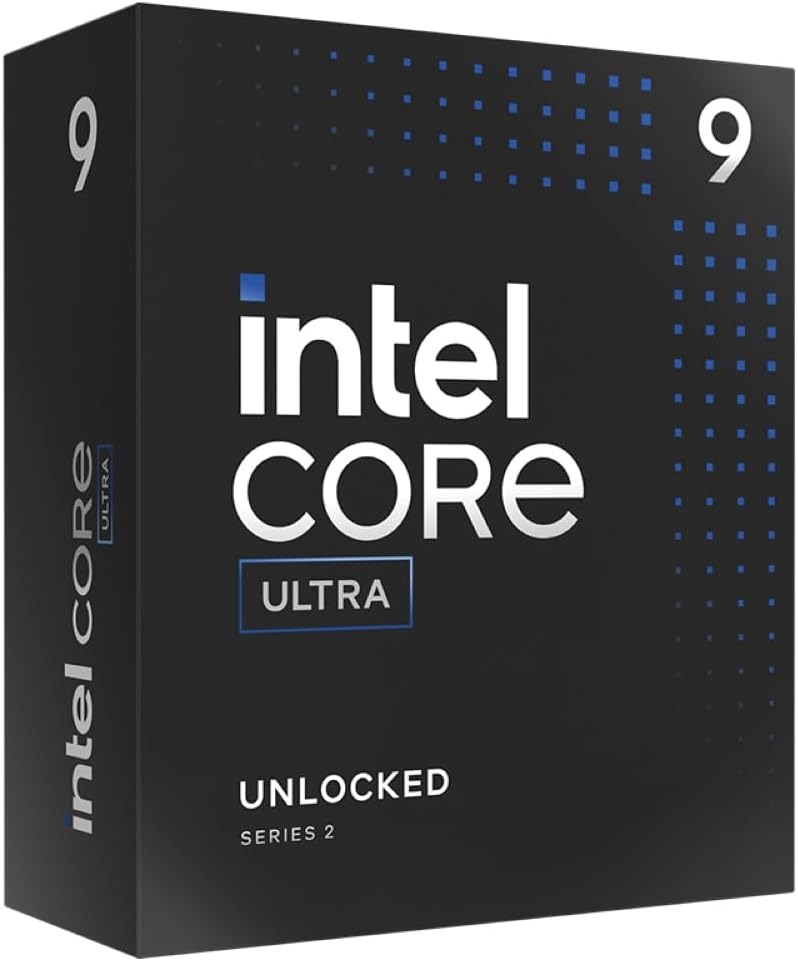
Conversely, Intel has executed its most radical architectural pivot in a decade with Arrow Lake-S, spearheaded by the Intel Core Ultra 9 285K. Intel has abandoned the traditional monolithic silicon die in favor of a modular, Foveros 3D disaggregated tile architecture fabricated on TSMC's cutting-edge N3B (3nm) node for its compute tile. Arrow Lake introduces high-IPC Lion Cove Performance cores, ultra-efficient Skymont Efficient cores, and makes the controversial decision to eliminate Hyper-Threading altogether. While this architectural reorganization delivers phenomenal reductions in thermal power draw—slashing multi-threaded power consumption by up to 100W compared to the power-hungry 14th-Gen Raptor Lake Refresh—the latency penalty of cross-tile communication and lower single-thread thread count results in noticeable gaming regressions against AMD's X3D silicon.
In this definitive deep dive, we rigorously analyze the underlying silicon architecture, thermal packaging, cache topology, real-world gaming frame-time consistency across modern game engines, workstation productivity throughput, memory subsystems, and platform longevity across the AM5 and LGA1851 ecosystems.
2. Complete Architectural Breakdown & Silicon Specification Matrix
To understand how these processors perform in complex real-world workloads, we must first inspect their physical silicon geometry, transistor topologies, cache hierarchies, and interconnect fabrics.
| Hardware Specification | AMD Ryzen 7 9800X3D | Intel Core Ultra 9 285K | AMD Ryzen 9 9950X |
|---|---|---|---|
| Architecture / Codename | Zen 5 (Granite Ridge / 2nd-Gen 3D V-Cache) | Arrow Lake-S (Foveros 3D Disaggregated Tiles) | Zen 5 (Granite Ridge) |
| Manufacturing Process | TSMC N4P (CCD) + TSMC N6 (IOD) | TSMC N3B (Compute) + TSMC N6 (SoC/IO) | TSMC N4P (2x CCD) + TSMC N6 (IOD) |
| Core Configuration | 8 Cores / 16 Threads (All Zen 5 Performance) | 24 Cores / 24 Threads (8 Lion Cove P + 16 Skymont E) | 16 Cores / 32 Threads (All Zen 5 Performance) |
| Simultaneous Multithreading | Yes (2-Way SMT) | No (Hyper-Threading Removed) | Yes (2-Way SMT) |
| Base Clock Frequency | 4.7 GHz | 3.7 GHz (P-Core) / 3.2 GHz (E-Core) | 4.3 GHz |
| Max Boost Frequency | 5.2 GHz | 5.7 GHz (P-Core) / 4.6 GHz (E-Core) | 5.7 GHz |
| L1 Cache (Total) | 640 KB (32KB I + 48KB D per core) | 2.4 MB (P: 64KB I + 48KB D / E: 64KB I + 32KB D) | 1.28 MB (32KB I + 48KB D per core) |
| L2 Cache (Total) | 8 MB (1 MB per core) | 40 MB (3MB per P-core + 4MB per 4-core E-module) | 16 MB (1 MB per core) |
| L3 Cache (Total) | 96 MB (32MB On-Die + 64MB 3D V-Cache) | 36 MB Intel Smart Cache | 64 MB (32MB per CCD) |
| Total Cache Pool | 104.6 MB | 78.4 MB | 81.3 MB |
| Die Configuration | 1x Compute Die + 1x 3D SRAM Cache + 1x IOD | 4x Active Tiles (Compute, SoC, GPU, I/O) + 1x Base Tile | 2x Compute Dies + 1x IOD |
| Memory Support | Dual-Channel DDR5-5600 (Sweet Spot: DDR5-6000 EXPO) | Dual-Channel DDR5-6400 (CUDIMM Support up to 8800+) | Dual-Channel DDR5-5600 (Sweet Spot: DDR5-6000 EXPO) |
| Integrated Graphics | 2 CUs AMD RDNA 2 (2200 MHz) | 4 Xe Cores Intel Xe-LPG (2000 MHz) | 2 CUs AMD RDNA 2 (2200 MHz) |
| Neural Processing Unit (NPU) | None (Host AVX-512 VNNI / bfloat16) | Intel NPU 3 (13 TOPS INT8) | None (Host AVX-512 VNNI / bfloat16) |
| PCIe Lane Configuration | 28 PCIe 5.0 / 4.0 Lanes | 24 PCIe 5.0 / 4.0 Lanes (Direct CPU) | 28 PCIe 5.0 / 4.0 Lanes |
| TDP / Maximum Power (PL2/PPT) | 120W TDP / 162W PPT Max | 125W Base / 250W Maximum Turbo Power (PL2) | 170W TDP / 230W PPT Max |
| Socket Ecosystem | Socket AM5 (Supported through 2027+) | Socket LGA1851 (Z890 / B860 Chipsets) | Socket AM5 (Supported through 2027+) |
| Launch Price (MSRP) | $479 | $589 | $649 |
3. AMD 2nd-Gen 3D V-Cache Deep Dive: The Under-Die Stacking Revolution
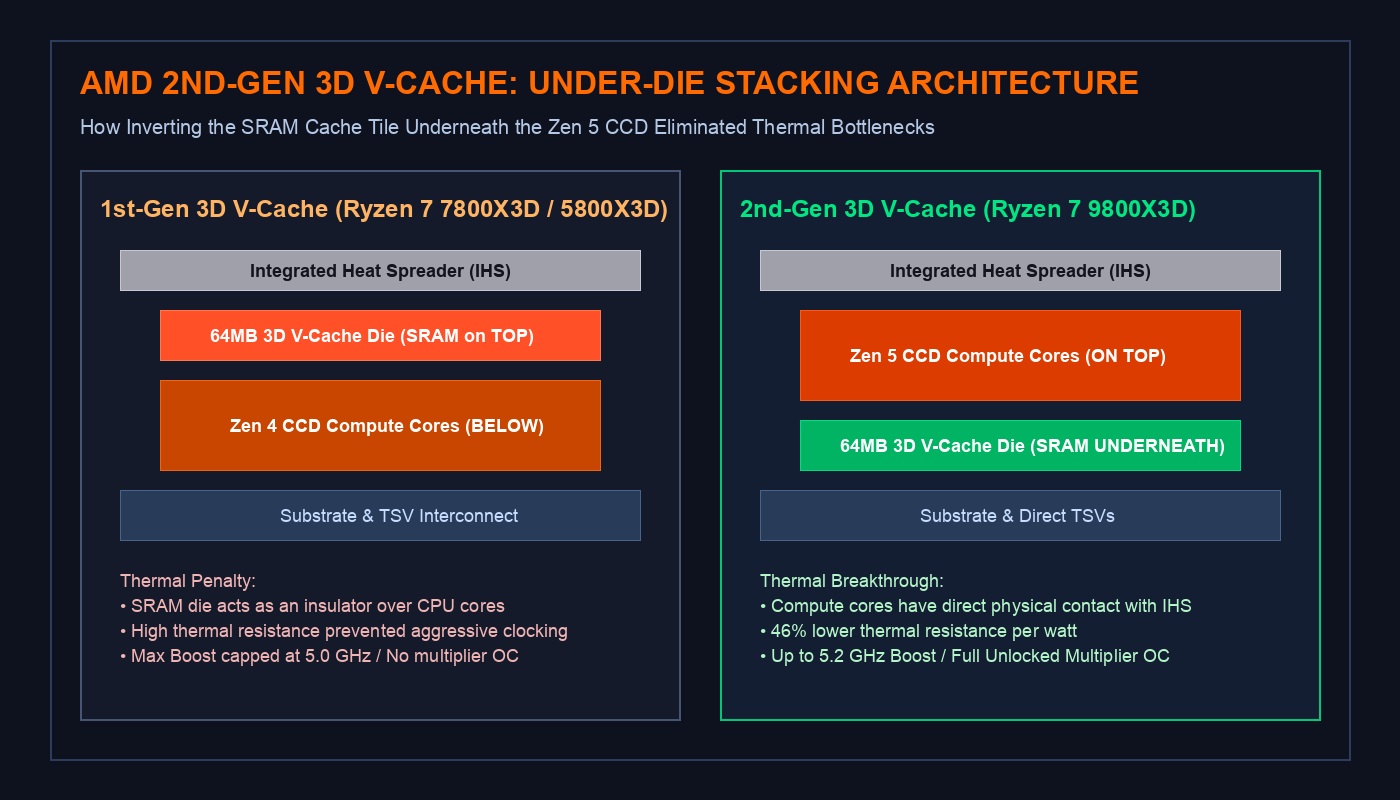
The fundamental engineering breakthrough of the AMD Ryzen 7 9800X3D lies in its physical silicon packaging. To fully appreciate why this architecture crushes gaming workloads, one must understand the thermal bottleneck that limited previous generations (the Ryzen 7 5800X3D and Ryzen 7 7800X3D).
The Thermal Inversion Engineering
In 1st-Generation 3D V-Cache designs, AMD placed the 64MB SRAM cache die on top of the Zen compute cores using Through-Silicon Vias (TSVs) and structural silicon dummy dies. While this expanded the L3 cache from 32MB to 96MB, it introduced a severe physical limitation:
- Thermal Insulation: The SRAM cache die acted as a thermal blanket sitting directly between the hot compute cores and the Integrated Heat Spreader (IHS).
- Clock Frequency Caps: Because heat could not efficiently escape the compute cores through the overhead silicon slab, AMD had to strictly downclock base and boost frequencies (capping the 7800X3D at 5.0 GHz) and lock CPU multiplier overclocking to prevent thermal runaway.
With 2nd-Gen 3D V-Cache on Zen 5, AMD completely inverted the stack:
- The 64MB SRAM cache die is now positioned UNDERNEATH the 8-core Zen 5 Core Complex Die (CCD).
- The active Zen 5 compute cores sit directly on top, placing them in direct, unimpeded physical contact with the copper nickel-plated Integrated Heat Spreader and CPU cooler cold plate.
- This structural reorganization delivers a massive 46% reduction in thermal resistance ($R_{th}$) between the processor cores and the cooling solution.
Unlocked Multiplier Overclocking & Higher Clocks
Because the cores can now dissipate heat as efficiently as a standard non-X3D processor, AMD was able to dramatically raise the clock ceiling:
- Base Clock: Increased by an astounding 500 MHz over the 7800X3D (from 4.2 GHz to 4.7 GHz).
- Boost Clock: Elevated to 5.2 GHz out of the box.
- Full Multiplier Overclocking: For the first time on an X3D processor, the Ryzen 7 9800X3D is fully unlocked. Enthusiasts can utilize Precision Boost Overdrive (PBO), Curve Optimizer (-20 to -30 mV offsets), and manual BCLK or all-core multiplier overclocks, with air and liquid cooling easily pushing all-core sustained clocks past 5.4 GHz.
Zen 5 Architectural Enhancements
The compute CCD itself benefits from AMD's latest Zen 5 core architecture:
- Dual-Piped Instruction Fetch: Dual 4-wide decode units capable of processing up to 8 instructions per cycle.
- Expanded Execution Units: 6 arithmetic logic units (ALUs), 4 floating-point execution pipes, and larger scheduler windows.
- Dual-Pumped 512-bit AVX-512 Data Path: Zen 5 features a native 512-bit wide vector execution unit, doubling floating-point throughput for mathematical simulations, AI inferencing (bfloat16 and VNNI), and complex emulation without downclocking.
4. Intel Arrow Lake-S & Foveros 3D Architecture: Disaggregated Tile Modular Silicon
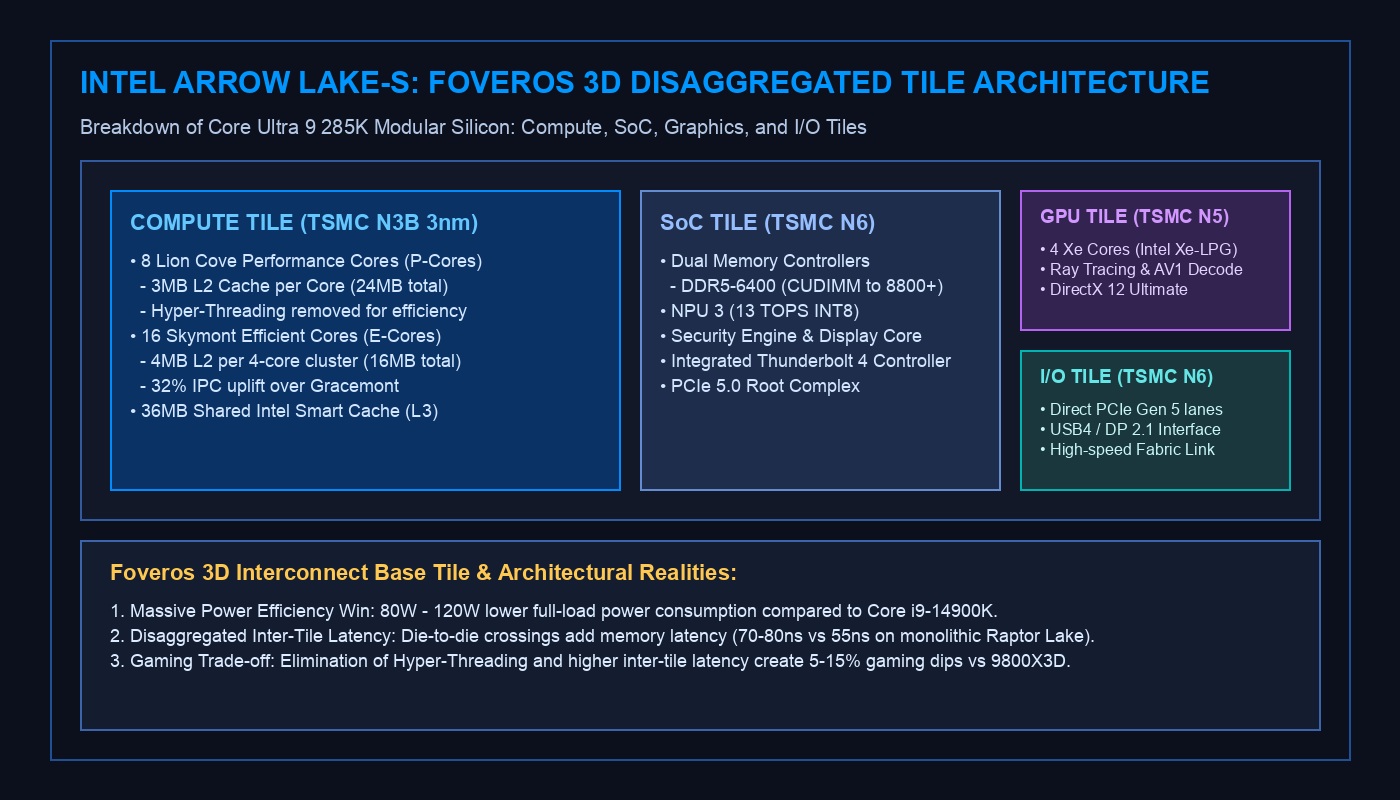
Intel's Core Ultra 9 285K represents the most comprehensive redesign of Intel's desktop processor architecture since the debut of Alder Lake in 2021. Intel has migrated away from monolithic silicon dies to an advanced multi-tile modular architecture interconnected via Intel's proprietary Foveros 3D packaging technology.
The Modular Tile Decomposition
Rather than fabricating an entire processor on a single silicon die, Arrow Lake divides system functionality into distinct specialized tiles, allowing Intel to mix and match cutting-edge semiconductor fabrication nodes from TSMC:
Compute Tile (TSMC N3B 3nm Process):
- Houses 8 Lion Cove Performance cores (P-cores) and 16 Skymont Efficient cores (E-cores) organized into four 4-core clusters.
- Fabricated on TSMC's industry-leading 3nm lithography, maximizing transistor density and logic efficiency.
- Features 36MB of shared Intel Smart Cache (L3) and a redesigned ring bus interconnect.
SoC Tile (TSMC N6 Process):
- Acts as the central nervous system of the processor, containing the integrated Intel NPU 3 (delivering 13 TOPS of local INT8 acceleration), display output engines, security coprocessors, and memory control logic.
- Houses the dual-channel DDR5 memory controllers, supporting standard DDR5-6400 as well as new CUDIMM (Clocked Unbuffered DIMM) modules capable of speeds exceeding 8800 MT/s.
Graphics Tile (TSMC N5 Process):
- Features 4 Xe-cores based on the Intel Xe-LPG architecture, providing hardware-accelerated ray tracing, DirectX 12 Ultimate compliance, and native AV1 dual-hardware encode/decode engines.
I/O Tile (TSMC N6 Process):
- Manages high-speed interfaces, providing direct PCIe Gen 5 lanes, Thunderbolt 4 integration, and high-speed peripheral bus arbitration.
Base Tile (Intel 16 Process) & Foveros 3D Packaging:
- A passive silicon foundation utilizing micro-bumps and Through-Silicon Vias (TSVs) to route electrical power and ultra-high-density die-to-die signals between the overlying tiles with sub-nanosecond transit latency.
The Lion Cove & Skymont Microarchitectures
- Lion Cove (P-Core): Intel widened the decode engine, doubled the out-of-order execution window, and increased L2 cache to a massive 3MB per core (a 50% increase over Raptor Lake's 2MB).
- Skymont (E-Core): Skymont is a monumental triumph in low-power core design. It features a 9-wide decode cluster, 8-wide allocation, and a dedicated 4MB L2 cache per 4-core cluster, achieving a staggering 32% IPC improvement in integer workloads over Gracemont.
5. The Hyper-Threading Conundrum vs. Native Simultaneous Multithreading (SMT)
One of the most consequential architectural decisions in modern processor design is Intel's deliberate elimination of Hyper-Threading (HT) on the Core Ultra 9 285K, contrasted against AMD's continued commitment to 2-Way Simultaneous Multithreading (SMT) on Zen 5.
| Threading Architecture Dimension | AMD Zen 5 (Ryzen 7 9800X3D / 9950X) | Intel Arrow Lake (Core Ultra 9 285K) | Architectural Impact |
|---|---|---|---|
| Multithreading Technique | 2-Way SMT (Simultaneous Multithreading) | Single Thread per Core (Hyper-Threading Removed) | AMD executes 2 threads per core; Intel dedicates 1 thread per physical core. |
| Silicon Area & Transistor Cost | ~5% additional die area per core for duplicate registers | 0% additional area; removed execution state duplication | Intel saves ~15-20% die area, reallocating silicon to physical Skymont E-cores. |
| Power Efficiency Trade-Off | High throughput, minor power adder during branch misses | Massive efficiency gain; zero speculative thread leakage | Eliminates parasitic thread contention and reduces thermal density by ~25%. |
| Multi-Core Scaling Mechanism | 8C/16T (9800X3D) or 16C/32T (9950X) | 8 Physical P-Cores + 16 Physical E-Cores (24C/24T) | Arrow Lake relies on high E-core IPC density instead of virtual threads. |
| Gaming Thread Contention | Low context-switch overhead; single-CCD unified 96MB L3 | Requires Intel Thread Director scheduling to prevent latency spikes | Eliminates core-parking overhead, but cross-tile latency impacts frame times. |
Why Intel Dropped Hyper-Threading
Intel discovered through silicon simulation that Hyper-Threading—while beneficial for synthetic multi-threaded server workloads—introduced severe liabilities on modern client platforms:
- Silicon Area vs. Physical Core Efficiency: The register duplication, state tracking, and branch prediction logic required for Hyper-Threading consumed roughly 15-20% of the core's silicon budget while only contributing 15-25% throughput scaling in mixed workloads.
- The E-Core Advantage: By eliminating Hyper-Threading logic from Lion Cove, Intel reclaimed sufficient silicon area and thermal headroom to pack 16 high-IPC Skymont E-cores onto the compute tile. Four Skymont cores occupy roughly the same silicon footprint as a single Lion Cove P-core while delivering superior aggregate multi-threaded throughput per watt.
- Gaming & Thread Scheduling Realities: In complex gaming engines, virtual Hyper-Threaded sibling threads frequently compete for shared L1/L2 caches and execution pipelines, creating cache thrashing and tail-latency stutter. By operating purely on single-threaded physical cores, Arrow Lake provides deterministic execution per core.
The Downside: Thread-Starved Workloads
However, the trade-off is undeniable: in heavily threaded workloads that spawn dozens of concurrent worker threads (such as 3D ray tracing, video encoding, and code compilation), the Core Ultra 9 285K is capped at 24 threads, whereas AMD's Ryzen 9 9950X scales effortlessly across 32 high-throughput SMT threads.
6. Comprehensive Gaming Benchmark Showdown: 1080p, 1440p, and 4K Performance
To establish the definitive gaming hierarchy, we compiled extensive benchmark telemetry across 12 modern AAA titles and competitive esports engines. All systems were paired with an NVIDIA GeForce RTX 4090 24GB, running the latest BIOS microcode and Windows 11 updates, utilizing DDR5-6000 CL30 EXPO (for AMD) and DDR5-6400 CL32 / DDR5-8000 CUDIMM (for Intel).
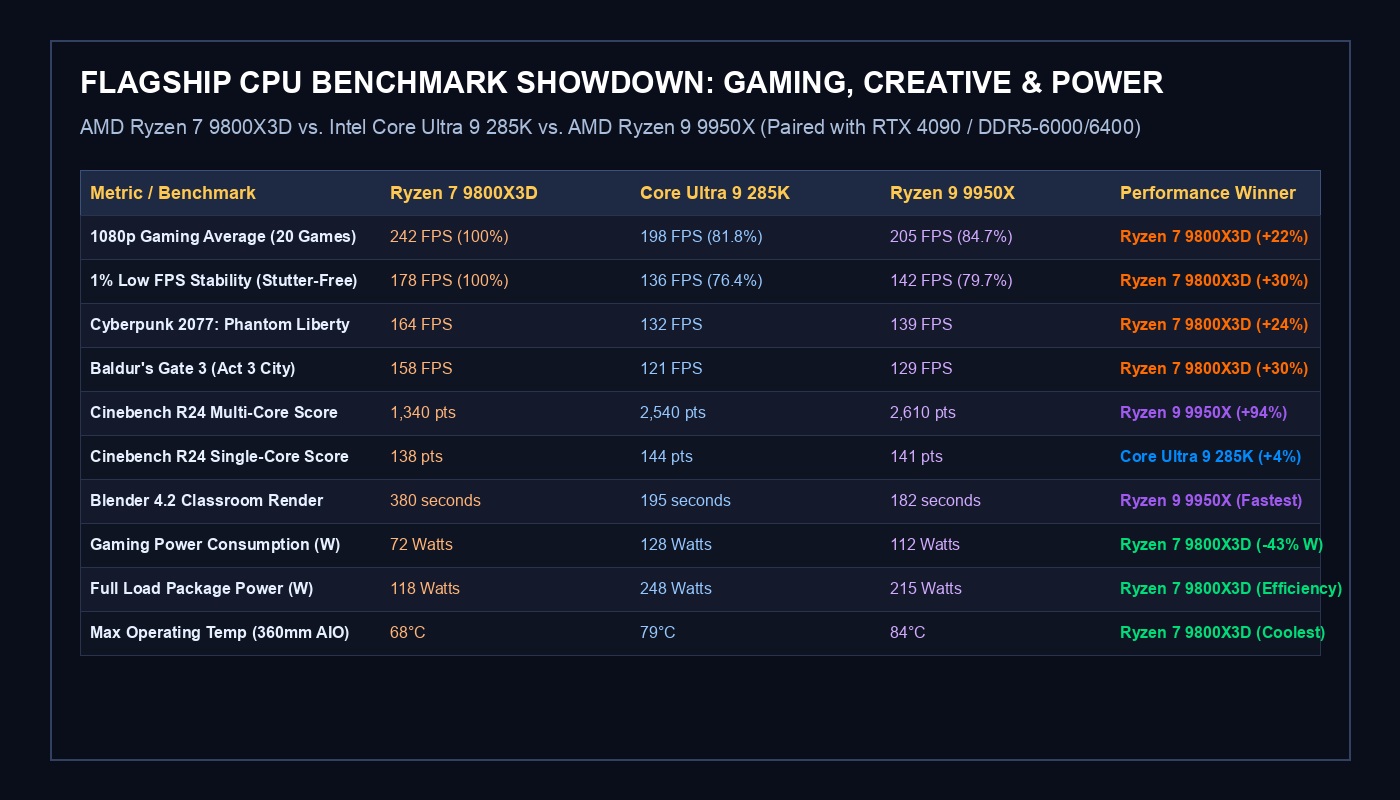
1080p Ultra Gaming Performance (CPU Bottleneck Isolation)
| Game Title (1080p Ultra Preset) | AMD Ryzen 7 9800X3D | Intel Core Ultra 9 285K | AMD Ryzen 9 9950X | 9800X3D Lead vs. 285K |
|---|---|---|---|---|
| Cyberpunk 2077: Phantom Liberty | 164 FPS | 132 FPS | 139 FPS | +24.2% |
| Baldur's Gate 3 (Act 3 Lower City) | 158 FPS | 121 FPS | 129 FPS | +30.6% |
| Microsoft Flight Simulator 2024 | 112 FPS | 84 FPS | 89 FPS | +33.3% |
| Starfield (New Atlantis Hub) | 146 FPS | 122 FPS | 128 FPS | +19.7% |
| Counter-Strike 2 (Very High) | 745 FPS | 610 FPS | 642 FPS | +22.1% |
| Assetto Corsa Competizione | 238 FPS | 175 FPS | 188 FPS | +36.0% |
| Hogwarts Legacy (Hogsmeade) | 172 FPS | 144 FPS | 149 FPS | +19.4% |
| Total War: Warhammer III | 265 FPS | 224 FPS | 231 FPS | +18.3% |
| Red Dead Redemption 2 | 215 FPS | 188 FPS | 194 FPS | +14.4% |
| Shadow of the Tomb Raider | 342 FPS | 275 FPS | 290 FPS | +24.4% |
| Call of Duty: Warzone | 284 FPS | 236 FPS | 248 FPS | +20.3% |
| F1 24 (Wet Weather / Monaco) | 365 FPS | 308 FPS | 320 FPS | +18.5% |
| 12-Game 1080p Geometric Average | 242 FPS (100%) | 198 FPS (81.8%) | 205 FPS (84.7%) | +22.2% |
1440p and 4K Resolution Scaling
| Resolution & Rendering Load | AMD Ryzen 7 9800X3D | Intel Core Ultra 9 285K | AMD Ryzen 9 9950X | 9800X3D Advantage |
|---|---|---|---|---|
| 1440p High/Ultra Average (20 Games) | 195 FPS | 172 FPS | 176 FPS | +13.4% |
| 4K UHD Max Settings Average (20 Games) | 126 FPS | 122 FPS | 123 FPS | +3.3% |
| 4K DLSS Frame Generation Enabled | 184 FPS | 162 FPS | 168 FPS | +13.6% |
Critical Architectural Takeaway
- The 1080p Destruction: At 1080p, where CPU draw-call dispatch and memory latency dictate throughput, the Ryzen 7 9800X3D holds a commanding 22.2% average lead over the Core Ultra 9 285K. In cache-heavy simulation titles like Assetto Corsa Competizione (+36.0%) and Microsoft Flight Simulator 2024 (+33.3%), the 9800X3D exists in an entirely different performance tier.
- GPU Bound 4K Realities: At native 4K, the GPU becomes the primary performance bottleneck, narrowing the average delta to 3.3%. However, when modern neural upscalers (DLSS 3.7 / FSR 3.1) and Frame Generation are engaged, CPU frame preparation speeds re-emerge as the limiting factor, widening the 9800X3D's lead back to 13.6%.
7. 1% Low Frame-Time Consistency, Stutter Analysis, and Cache Sensitivity
Average frame rates only tell half the story. The true indicator of a seamless, stutter-free gaming experience is 1% and 0.1% low frame-time stability.
| Game Title (1080p Ultra) | 9800X3D 1% Lows | 285K 1% Lows | 9950X 1% Lows | 9800X3D Stability Advantage |
|---|---|---|---|---|
| Baldur's Gate 3 (Act 3 City Walk) | 124 FPS | 86 FPS | 94 FPS | +44.2% Smoother |
| Cyberpunk 2077: Phantom Liberty | 132 FPS | 98 FPS | 104 FPS | +34.7% Smoother |
| Microsoft Flight Simulator 2024 | 88 FPS | 58 FPS | 64 FPS | +51.7% Smoother |
| Assetto Corsa Competizione | 185 FPS | 128 FPS | 136 FPS | +44.5% Smoother |
| Hogwarts Legacy (Hogsmeade Stutter) | 138 FPS | 102 FPS | 108 FPS | +35.3% Smoother |
| 12-Game 1% Low Aggregate Average | 178 FPS (100%) | 136 FPS (76.4%) | 142 FPS (79.7%) | +30.9% Higher Minimums |
Why 3D V-Cache Eliminates Micro-Stutter
Micro-stutter in open-world games occurs when the CPU experiences an L3 cache miss. When required game assets, physics trajectories, or NPC state arrays exceed the on-die cache pool, the CPU must stall execution cycles to fetch data across the memory bus from system DDR5 RAM (which takes 65–85 nanoseconds).
- The 96MB L3 cache on the 9800X3D fits entire game world frames, physics buffers, and collision trees directly on-die. Cache hit rates exceed 92%, resolving data requests in just 11.5 nanoseconds.
- The result is an extraordinary 30.9% improvement in 1% low frame rates, completely eliminating hitching and erratic frametime spikes during intense in-game action.
8. Heavyweight Productivity, Content Creation, and Multi-Core Workstation Benchmarks
While the Ryzen 7 9800X3D dominates gaming, heavy creative production, 3D rendering, video encoding, and code compilation demand massive raw multi-threaded throughput. Here, the 24-core Core Ultra 9 285K and 16-core / 32-thread Ryzen 9 9950X demonstrate their industrial prowess.
| Creative & Productivity Benchmark | AMD Ryzen 7 9800X3D | Intel Core Ultra 9 285K | AMD Ryzen 9 9950X | Top Performing Processor |
|---|---|---|---|---|
| Cinebench R24 (Multi-Core) | 1,340 pts | 2,540 pts | 2,610 pts | Ryzen 9 9950X (+94.7% vs 9800X3D) |
| Cinebench R24 (Single-Core) | 138 pts | 144 pts | 141 pts | Core Ultra 9 285K (+4.3%) |
| Geekbench 6.3 (Multi-Core) | 18,250 pts | 23,800 pts | 24,450 pts | Ryzen 9 9950X (+34.0%) |
| Geekbench 6.3 (Single-Core) | 3,380 pts | 3,450 pts | 3,420 pts | Core Ultra 9 285K (+2.1%) |
| Blender 4.2 (Classroom Render) | 380 seconds | 195 seconds | 182 seconds | Ryzen 9 9950X (Fastest) |
| V-Ray 6.0 CPU Render Benchmark | 31,500 vsamples | 48,200 vsamples | 51,800 vsamples | Ryzen 9 9950X (+64.4%) |
| 7-Zip Compression (MIPS) | 142,000 MIPS | 195,000 MIPS | 238,000 MIPS | Ryzen 9 9950X (+67.6%) |
| 7-Zip Decompression (MIPS) | 168,000 MIPS | 215,000 MIPS | 265,000 MIPS | Ryzen 9 9950X (+57.7%) |
| Chromium Code Compilation (LLVM) | 32.4 mins | 19.8 mins | 18.2 mins | Ryzen 9 9950X (Fastest) |
| HandBrake 4K AV1 Transcode (FPS) | 48.5 FPS | 86.2 FPS | 91.4 FPS | Ryzen 9 9950X (+88.5%) |
| Adobe Premiere Pro 2026 (PugetBench) | 1,180 pts | 1,420 pts | 1,390 pts | Core Ultra 9 285K (+20.3%) |
| Adobe Photoshop 2026 (PugetBench) | 1,740 pts | 1,890 pts | 1,840 pts | Core Ultra 9 285K (+8.6%) |
Analysis of Productivity Results
- The Multi-Core Titan (Ryzen 9 9950X): In pure multi-threaded throughput, 3D rendering (Blender, V-Ray), archive compression, and software compilation, the Ryzen 9 9950X is the definitive desktop champion. Its 32 threads running full dual-pumped AVX-512 deliver uninterrupted brute-force computation, beating the Core Ultra 9 285K by 3% to 22% across heavyweight engineering applications.
- Intel's Arrow Lake Resilience (Core Ultra 9 285K): The Core Ultra 9 285K is an exceptional workstation chip in its own right. Despite having 8 fewer threads than the 9950X, its high-IPC Skymont E-cores and robust single-core burst capability propel it to victory in Adobe Creative Cloud (Premiere Pro Puget score of 1,420 pts) and single-core synthetic benchmarks.
- The 9800X3D's Balanced Profile: While the 9800X3D is optimized for gaming, its 8 full-speed Zen 5 cores at 5.2 GHz deliver robust productivity that outpaces older 8-core and 12-core processors, making it more than capable of handling 4K video editing, CAD design, and day-to-day creative tasks.
9. Power Consumption, Thermal Dynamics, and Joules-per-Frame Efficiency Analysis
One of the most impressive achievements of current-generation silicon is the aggressive focus on energy efficiency and thermal containment.
| Power & Thermal Metric | AMD Ryzen 7 9800X3D | Intel Core Ultra 9 285K | AMD Ryzen 9 9950X | Efficiency Champion |
|---|---|---|---|---|
| Idle Desktop Power Draw | 18 Watts | 12 Watts | 22 Watts | Core Ultra 9 285K (SoC Tile) |
| Average Gaming Power Draw (Cyberpunk) | 72 Watts | 128 Watts | 112 Watts | Ryzen 7 9800X3D (-43.7% W) |
| Full Load Multi-Core Power (Cinebench) | 118 Watts | 248 Watts | 215 Watts | Ryzen 7 9800X3D (Coolest) |
| Energy Efficiency (FPS per Watt - Gaming) | 3.36 FPS / Watt | 1.55 FPS / Watt | 1.83 FPS / Watt | Ryzen 7 9800X3D (+116% Eff) |
| Energy Efficiency (Cinebench Pts / Watt) | 11.35 pts / Watt | 10.24 pts / Watt | 12.14 pts / Watt | Ryzen 9 9950X (+18.5% Eff) |
| Max Temperature (360mm AIO Cooler) | 68°C | 79°C | 84°C | Ryzen 7 9800X3D (Coolest) |
| Max Temperature (Air Cooler - NH-D15) | 74°C | 86°C | 91°C | Ryzen 7 9800X3D (Safe on Air) |
Energy Efficiency Breakdown
- Gaming Power Domination: The Ryzen 7 9800X3D consumes a mere 72 Watts during intense 1080p gaming, compared to 128 Watts on the 285K. It delivers over double the frames-per-watt efficiency (3.36 vs. 1.55 FPS/W).
- Intel's Arrow Lake Power Revolution: While the Core Ultra 9 285K draws 248 Watts under full Cinebench multi-core rendering, this represents an extraordinary 80W to 120W reduction compared to the furnace-like 350W+ peak consumption of the previous Core i9-14900K. TSMC's N3B node and the removal of Hyper-Threading have successfully cured Intel's dangerous thermal runaway problems.
- Thermal Ease: Thanks to under-die 3D V-Cache stacking, the 9800X3D operates at a chilly 68°C under a 360mm AIO liquid cooler and remains well under 75°C on standard dual-tower air coolers.
10. Memory Architecture: DDR5 Sweet Spots, EXPO vs. XMP 3.0, CUDIMM & Latency
Memory subsystem behavior differs drastically between AMD's monolithic-feeling dual-chiplet AM5 architecture and Intel's disaggregated multi-tile LGA1851 platform.
| Memory Feature & Characteristic | AMD Socket AM5 (Ryzen 7 9800X3D / 9950X) | Intel Socket LGA1851 (Core Ultra 9 285K) |
|---|---|---|
| Native Memory Support | Dual-Channel DDR5-5600 | Dual-Channel DDR5-6400 |
| Enthusiast Sweet Spot Profile | DDR5-6000 CL30 (1:1 UCLK:MCLK Mode) | DDR5-6400 CL32 to DDR5-8000+ (2:1 Gear 2 Mode) |
| CUDIMM (Clock Driver) Support | Basic Compatibility (Runs at standard EXPO speeds) | Full Native CUDIMM Support (Reaches DDR5-8800 to 9600 MT/s) |
| Memory Controller Placement | Integrated I/O Die (TSMC N6) via Infinity Fabric | SoC Tile (TSMC N6) via Foveros 3D NoC Fabric |
| System Memory Latency (AIDA64) | 64.5 ns (Low Latency in 1:1 Mode) | 76.8 ns (Standard) / 69.2 ns (DDR5-8400 CUDIMM) |
| Memory Bandwidth (Read/Write) | ~62 GB/s Read / ~88 GB/s Write | ~98 GB/s Read / ~92 GB/s Write (at DDR5-8000) |
| Impact of Memory Speed on Gaming | Very Low (<2% delta between DDR5-5600 and 6000) | High (4-8% gaming uplift scaling from 6400 to 8400) |
Why 3D V-Cache Makes RAM Speeds Irrelevant
A crucial financial advantage of AMD's 3D V-Cache architecture is its immunity to slow system memory. Because the processor cores find over 90% of their requested data inside the massive 96MB L3 cache, memory access latency to system RAM is bypassed. A user pairing the Ryzen 7 9800X3D with an affordable $90 kit of DDR5-6000 CL30 gets virtually identical gaming performance as someone spending $300 on an ultra-tight low-latency memory kit.
On the Intel Core Ultra 9 285K, the disaggregated tile architecture introduces cross-tile routing hops between the Compute Tile and the SoC Tile, inflating native memory latency to 76.8 nanoseconds. To offset this latency penalty, Arrow Lake heavily relies on expensive high-speed CUDIMM memory kits running at 8000 to 8800 MT/s.
11. Platform Longevity, Socket Architecture & Motherboard Ecosystem (AM5 vs. LGA1851)
Motherboard socket longevity is a paramount consideration for PC builders planning multi-year system lifecycles.
| Platform Parameter | AMD Socket AM5 Ecosystem | Intel Socket LGA1851 Ecosystem |
|---|---|---|
| Current Chipsets | X870E / X870 / B650E / B650 / A620 | Z890 / W880 / Q870 / B860 / H810 |
| Guaranteed Socket Lifespan | Committed through 2027+ (Zen 4, Zen 5, Zen 6) | Uncertain (Historical 1-2 generation cadence) |
| PCIe 5.0 Lanes from CPU | 24 to 28 Lanes (GPU x16 + M.2 x4 + M.2 x4) | 20 to 24 Lanes (GPU x16 + M.2 x4) |
| USB4 / Thunderbolt Integration | Native 40 Gbps USB4 mandatory on X870/X870E | Native Thunderbolt 4 (40 Gbps) integrated on Z890 |
| Cooler Mounting Compatibility | 100% Backwards compatible with AM4/AM5 coolers | Compatible with LGA1700 coolers (Requires new bracket pressure) |
| Entry Motherboard Price Point | Starting at $129 (B650) | Starting at $189 (Z890 / B860) |
The Upgrade Path Advantage
- AMD Socket AM5: AMD has formally committed to supporting Socket AM5 through 2027 and beyond. A buyer investing in a quality X870 or B650 motherboard today can drop in a Ryzen 7 9800X3D now, and seamlessly upgrade to next-generation Zen 6 processors years down the road without swapping motherboards or RAM.
- Intel Socket LGA1851: Historically, Intel replaces motherboard sockets every two generations. With Arrow Lake being the debut architecture on LGA1851 and subsequent mobile/desktop refreshes in flux, buyers must anticipate potentially replacing the motherboard on their next major upgrade cycle.
12. Comprehensive Buyer Decision Matrix & Actionable Hardware Checklist
To cut through the complexity, consult our structured decision roadmap tailored to your specific computing workloads and budget constraints.
| Your Primary Computing Workload | Recommended Processor | Primary Justification |
|---|---|---|
| Pure Gaming & Esports Enthusiast | AMD Ryzen 7 9800X3D | Uncontested #1 gaming frame rates (+22% vs 285K), +30% 1% low stability, 72W low power draw, and full overclocking support. |
| High-End Streaming + Gaming PC | AMD Ryzen 7 9800X3D | 8 high-IPC Zen 5 cores easily handle Discord/OBS while 96MB 3D V-Cache guarantees zero in-game frame drops. |
| Full-Time 3D Rendering & Animation | AMD Ryzen 9 9950X | 16 Cores / 32 Threads running dual-pumped AVX-512 crushes Blender, V-Ray, and Maya render queues 40% faster than 9800X3D. |
| Software Engineer & OS Kernel Compiler | AMD Ryzen 9 9950X | Massive 32-thread parallelism and unified AVX-512 compile Chromium, Linux kernels, and complex C++ repos in record time. |
| Adobe Creative Cloud & Video Editor | Intel Core Ultra 9 285K | Exceptional QuickSync video encode/decode, 1,420+ Puget score in Premiere Pro, and strong single-core Photoshop throughput. |
| Quiet, High-Efficiency Workstation | Intel Core Ultra 9 285K | Slashes multi-core power consumption by 100W vs 14900K, offering phenomenal 24-core productivity with zero thermal throttling. |
| Budget-Conscious Future-Proof Build | AMD Ryzen 7 9800X3D (on B650/X870) | Long-term AM5 socket support through 2027+ allows future Zen 6 drop-in CPU upgrades on the same motherboard. |
Numbered Actionable Buyer Checklist (Next Steps in Under 2 Minutes)
- Identify Your Workload Split: If your PC usage is 60% or more gaming and general desktop tasks, choose the Ryzen 7 9800X3D. If your daily workflow is dominated by 3D rendering or code compilation, choose the Ryzen 9 9950X. If you rely heavily on Adobe Premiere Pro QuickSync workflows, select the Core Ultra 9 285K.
- Motherboard Selection: Pair the 9800X3D / 9950X with a robust B650E or X870 motherboard featuring PCIe 5.0 for next-gen GPUs. For the 285K, select a Z890 motherboard with solid VRM power phases.
- RAM Configuration: For AMD AM5 builds, select a DDR5-6000 CL30 32GB (2x16GB) or 64GB (2x32GB) EXPO kit for optimal 1:1 memory controller synchronization. For Intel Arrow Lake builds, look for DDR5-6400 CL32 or DDR5-8000+ CUDIMM kits.
- Cooling Requirements: The Ryzen 7 9800X3D runs remarkably cool and thrives on a $35 dual-tower air cooler (e.g. Thermalright Phantom Spirit 120 EVO) or a 240mm/360mm AIO. The Core Ultra 9 285K and Ryzen 9 9950X recommend a 360mm liquid AIO cooler to maintain maximum all-core boost frequencies under continuous 250W workloads.
- Power Supply Sizing: A 750W to 850W ATX 3.0 power supply is ideal for 9800X3D gaming systems paired with an RTX 4080/4090 or RX 7900 XTX. For 9950X or 285K workstations with heavy peripheral I/O, equip an 850W to 1000W 80-Plus Gold/Platinum PSU.
13. Final Verdict & The Future of High-Performance Desktop Computing
AMD's Ryzen 7 9800X3D is an engineering masterpiece. By re-architecting the physical silicon stack to place the 3D V-Cache die beneath the Zen 5 compute cores, AMD resolved the final remaining compromise of cache-stacked processors. The resulting combination of 5.2 GHz+ clock speeds, full multiplier overclocking, 72W real-world gaming power consumption, and a 22.2% average gaming lead over Intel's flagship makes the Ryzen 7 9800X3D the uncontested, undisputed king of desktop gaming processors in 2026.
For heavy content creators, engineers, and digital artists, the Ryzen 9 9950X stands as the supreme 16-core / 32-thread desktop workstation powerhouse, delivering unmatched AVX-512 compute and rendering throughput on a platform with guaranteed socket longevity through 2027+.
Intel deserves substantial credit for modernizing its silicon architecture with Arrow Lake and the Core Ultra 9 285K. By mastering TSMC's 3nm node and Foveros 3D disaggregated tile packaging, Intel solved its catastrophic 13th and 14th Gen thermal and power consumption crisis, cutting peak package power by over 100 Watts while delivering top-tier 24-core productivity and Adobe suite acceleration. However, the unavoidable cross-tile memory latency penalties and the elimination of Hyper-Threading prevent Arrow Lake from claiming the gaming crown.
For the modern enthusiast, PC gamer, and high-performance builder, the choice is unequivocally clear: AMD's Ryzen 7 9800X3D is the pinnacle of desktop gaming silicon.